

Every Square on the Periodic Table Is a Job Description
Chemical elements and their uses follow a pattern: where an element sits on the periodic table predicts the job it does in your house, car, and body.
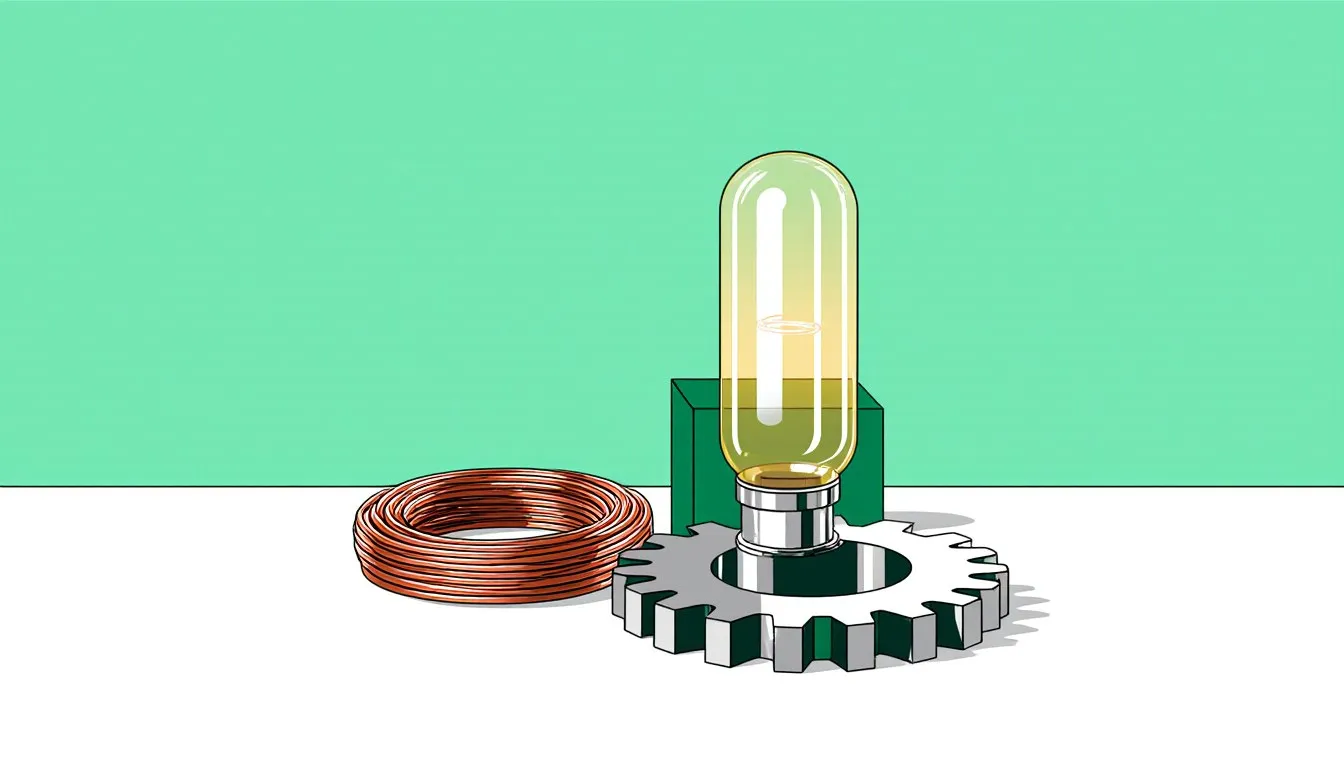
Copper is in your walls because of one loosely held electron. That outermost electron drifts through the metal lattice with very little to stop it. Down at the atomic level, that drift is all “conducts electricity” means. It is also why the wiring behind your light switch is copper and not lead, which carries current about a twelfth as well by volume. Every practical use of every element traces back to something that specific: how many electrons sit in the outer shell, how tightly the nucleus holds them, and how badly the atom wants one or two more.
Learn to read that off the chart and the periodic table stops being a poster on a classroom wall and becomes a shop floor, with 118 known elements standing at their stations. The analogy has a limit worth naming now: no element holds a single job. Carbon works in steel, in pencils, in diamond drill bits, and in every molecule you are made of. A column tells you what an atom wants chemically, and that same want can be put to work in a dozen unrelated industries at once.
Iron is holding up your roof. Argon is sitting inert inside your double-glazed windows so the heat stays put. Calcium is in your skeleton, phosphorus is in every strand of your DNA, and a few milligrams of indium are spread in a transparent film across the screen you are reading this on. What follows is that shop floor, walked family by family, each element standing next to the work it is good at. Meet an element you have never heard of and you can look at where it sits and make a decent guess about what it does for a living.
What makes an element useful in the first place?
Usefulness starts with electron structure. Abundance mostly decides the price.
Take two metals that could not be more different in reputation. Gold is scarce, and it is prized in large part because it does almost nothing: it does not tarnish in air, it shrugs off most acids, and it will sit in a shipwreck for four centuries and come up looking like it did on the day it went down. That refusal to react follows directly from how tightly gold holds its outer electrons. It is also why gold plating shows up on connector pins inside computers. An oxide layer even a few atoms thick would raise the contact resistance across that joint, and a signal that has to cross a thousand such joints cannot afford it. The full picture of the chemical properties of gold is worth a detour if that combination of laziness and value interests you.
Iron is the opposite temperament. It is the fourth most abundant element in Earth’s crust, it reacts with oxygen and water enthusiastically enough to destroy bridges, and we build the modern world out of it anyway, because iron atoms in a crystal lattice bond in a way that resists being pushed sideways. Strength per dollar has no serious competitor. We accept the rusting and manage it with paint, galvanizing, and alloying.
An element’s job is whatever its electron arrangement makes it do reliably. Excite neon at low pressure and it glows a particular red-orange, drawing little enough power that the tube runs warm rather than hot, and tubes in old shop signs have gone on glowing for decades. Helium will not freeze at any temperature you can reach at ordinary pressure. Hold it near 4 kelvin and it stays a liquid, which is exactly the condition an MRI magnet needs to keep its coils superconducting. In both cases the atom does one narrow thing perfectly and repeatedly, and an industry grew up around it.
How does the periodic table predict what an element does for a living?
The chart is arranged so that behavior repeats down the columns. Read a row left to right and you are watching electrons fill up a shell one at a time. Drop down a column and you find atoms that all have the same number of outer electrons, which means they all want the same things chemically, just with increasing size and heft as you go down.
That is why the columns are families with family traits. Column 1, the alkali metals, all carry a single outer electron they are eager to hand off, so all of them react with water and none of them are found free in nature. Column 17, the halogens, are all one electron short of a full shell, so all of them are grabby, and all of them form salts with column 1. The far right column has full shells and wants nothing, which is the entire basis of the noble gas business.
Dmitri Mendeleev built the first version of this arrangement in 1869 by sorting the elements known at the time and noticing that properties recurred at regular intervals. His radical move came next. He left blank squares where the pattern demanded an element nobody had found yet, then predicted the density and melting behavior of the missing occupants. When gallium and germanium turned up and matched his predictions closely, the argument was over. Modern IUPAC convention orders the table by atomic number, the count of protons in the nucleus. Mendeleev did not have that number to work with. The pattern holds up better for it.
Practically, this gives you a map with four broad neighborhoods:
- The metals, occupying most of the chart, which hold their outer electrons loosely and therefore conduct, bend, and shine.
- The reactive nonmetals, over on the right, which pull electrons in and form the bulk of the compounds you eat, breathe, and clean with.
- The metalloids, a diagonal staircase between the two, which are indecisive in a way that turns out to be extraordinarily valuable.
- The noble gases, the far-right column, useful precisely because they will not participate.
Why does a chart with ninety metals on it come down to about a dozen?
There are roughly ninety metals on the chart and about a dozen doing nearly all the work. Each one dominates its niche because of one standout property.
Why is pure iron useless until you add carbon?
Pure iron is soft enough to be nearly useless structurally. Add carbon at under about two percent and the carbon atoms wedge into the iron lattice and stop the planes of atoms from sliding over one another, and you have steel. Vary the carbon, add chromium or nickel or manganese, quench it or let it cool slowly, and you get a family of materials ranging from soft wire to a drill bit that cuts other steel. Nearly every structure you have ever walked into is standing on this one trick. Iron’s downside is the honest one: its oxide flakes off instead of protecting the metal underneath, so rust keeps working inward through fresh metal for as long as there is metal left. Set the physical properties of iron beside aluminum’s and that one difference in how each oxide behaves does most of the explaining.
Why do copper and aluminum move electrons and heat so well?
Copper conducts electricity better than any metal except silver, and silver costs too much to run through your attic. Copper also draws into wire without snapping and solders cleanly, which is why the uses of copper wire in a single house run all the way from the service panel down to the doorbell transformer. It carries heat just as well, which is why the base of a good saucepan is often a copper slug sandwiched in steel.
Aluminum conducts about sixty percent as well as copper for a given thickness, and it wins anyway on overhead power lines. Students get tripped up here every year, so check your units. Per unit of volume, copper wins comfortably. Per unit of mass, aluminum wins, because it is roughly a third as dense.
A transmission line hangs between towers under its own weight. Mass is the constraint that matters, so aluminum is the right answer. It also grows a thin, tight oxide skin that seals the surface instead of flaking, which is what keeps a ladder left out all winter from disintegrating.
Aluminum is the most abundant metal in the crust, and it still stayed a curiosity until electrolysis made it cheap to pull away from its ore. That same electricity bill is why recycling it takes a small fraction of the energy of smelting new metal. Kitchen foil and airframes sit at opposite ends of the uses of aluminum, and both trade on the same two facts: it is light, and it seals its own surface.
What jobs do gold and platinum get hired for?
Both sit among the noble metals, and both are hired for their inertness. Gold goes onto electrical contacts and into dentistry. Platinum melts at about 1768 degrees Celsius (3214 degrees Fahrenheit) and stays chemically indifferent right up until it gets there, which makes it the material for laboratory crucibles you intend to reuse. Its more important job is catalysis: platinum, palladium, and rhodium in a car’s catalytic converter hold exhaust molecules on their surface just long enough to react with each other, then release them, coming out the far end unchanged. Converters, refinery catalysts, and hydrogen fuel cell electrodes account for most of the common uses of platinum by tonnage, and catalysis alone takes the larger share of the annual supply.
What makes titanium worth the price?
Titanium’s whole case is a ratio. It has strength in the range of many structural steels at roughly 57 percent of the density, and like aluminum it forms a self-repairing oxide film, one so stable that titanium sits in seawater for years without pitting. That combination is why it appears in jet engine compressor sections, in marine hardware, and in surgical implants, where the body tolerates it well. The price comes from the separation step. Titanium clings hard to oxygen, and prying the two apart takes slow, batch-by-batch work at high temperature. That work is most of what you pay for. The conditions that justify that bill are narrow. The part has to be fighting its own weight, or sitting in salt water, and often it is doing both at once. That pair sits behind nearly every titanium component you will ever come across, which is how a bicycle frame and a seawater pump fitting end up made of the same expensive metal.
What do oxygen, chlorine, sulfur, and phosphorus have in common?
These elements earn their keep by reacting. They sit on the right side of the chart, they pull electrons toward themselves, and they show up almost everywhere as compounds rather than as pure substances.
Oxygen makes up about 21 percent of the air by volume and about 46 percent of Earth’s crust by mass, which makes it the most abundant element under your feet as well as the one keeping you upright. Industrially, the largest single consumer of purified oxygen is steelmaking, where it is blown through molten iron to burn off surplus carbon quickly. It also drives welding torches, wastewater treatment, and rocket engines. Steel mills, welding shops, sewage plants, launch pads. Every one of those buyers wants the same thing from it. An energy-releasing reaction needs an oxidizer, and this is the cheap one.
Chlorine sits one electron short of a full shell and behaves accordingly. That grabbiness is exactly what makes it a disinfectant: at the low concentrations used in municipal drinking water and pools, it attacks the cell membranes of microorganisms. A larger share of the world’s chlorine never touches water at all and goes instead into making PVC pipe, solvents, and pharmaceuticals, because chlorine is a convenient handle for building larger organic molecules. By tonnage, more chlorine ends up bonded into plastics and drug molecules than ever reaches a tap or a pool.
Sulfur is yellow, brittle, and responsible for the highest-tonnage industrial chemical on the planet. Sulfuric acid is made from it, and most of that acid goes into processing phosphate rock into fertilizer, which means sulfur is quietly upstream of a large share of the world’s food. It has a second career in rubber: Charles Goodyear’s vulcanization process uses sulfur atoms to bridge between long polymer chains, turning a substance that sagged in summer heat into a tire. Fertilizer and tires take most of the tonnage. Gunpowder and vineyard fungicides are the interesting leftovers, and growers have dusted vines with sulfur since long before anyone could explain why it worked.
Phosphorus is in every cell you have. The backbone of DNA is a chain of alternating sugar and phosphate groups, and ATP, the molecule your cells use to move energy around, is built around a string of three phosphates. Mined phosphate rock goes to fertilizer, and the red allotrope is what makes the striking strip on a matchbox work. White phosphorus, by contrast, ignites in air and belongs nowhere near a home. Biology and combustion look like an odd pair until you notice the chemistry underneath both. Phosphorus bonds to oxygen hard, and it gives up a great deal of energy doing it, whether you are striking a match or running a cell.
Where does the chart stop being metal and start being nonmetal?
Along the diagonal staircase separating metals from nonmetals sit boron, silicon, germanium, arsenic, antimony, and tellurium. They conduct, but badly, and that mediocrity is the entire point.
Silicon has four outer electrons, exactly half a full shell. It forms a rigid crystal in which every atom bonds neatly to four neighbors, with almost no electrons left free to move. Add a trace of an element with five outer electrons, or one with three, and you introduce a controlled surplus or shortage of charge carriers. A conductor you can switch on and off is the foundation of every transistor ever made, and there are billions of them in the device in your hand. Silicon is also the second most abundant element in the crust, mostly locked up as silicon dioxide, which is to say sand, quartz, and most of the glass you have ever looked through. One atom ended up naming an entire valley, which is a fair measure of how much rests on those four outer electrons.
Boron ends up in borosilicate glass, where it lowers thermal expansion enough that a hot dish does not crack when it meets a cold counter. Every lab bench beaker relies on that. Germanium carried the first transistors before silicon took over, and it kept the jobs silicon cannot do. It is transparent to the mid-infrared wavelengths a thermal camera sees by, so the lens in front of that sensor is usually germanium. A trace of it raised into the core of a glass fiber bends light back toward the middle, which is how a pulse survives a hundred kilometers without smearing into the one behind it. Antimony hardens soft lead alloys, and as its oxide it interrupts the chain reaction that lets a plastic keep burning once lit. Tellurium pairs with cadmium in thin-film solar panels, and a fraction of a percent of it makes copper and steel cut cleanly instead of tearing on the lathe.
Why would anyone pay for a gas that refuses to react?
Full outer shells, no chemical appetite, and a long list of jobs that exist only because of that indifference.
Argon is the workhorse. It makes up about 0.93 percent of the atmosphere by volume, which puts it third behind nitrogen and oxygen and ahead of every other gas in the air, carbon dioxide included. That abundance is why it is cheap to separate from liquefied air, and cheapness is half the reason it gets used at all. Welders flood the arc with it to keep atmospheric oxygen and nitrogen away from molten metal. It fills the gap in double-glazed windows because it conducts heat more poorly than air. Museums use it to store documents that would otherwise slowly oxidize. Nearly all argon uses come down to the same sentence: put argon there so that nothing happens.
Helium is the second lightest element and boils at about 4.2 kelvin, close enough to absolute zero that liquid helium is the standard coolant for superconducting magnets in MRI scanners and particle accelerators. It also leaks through the smallest cracks faster than any other gas, which makes it the tracer of choice for leak testing sealed systems. Party balloons are a rounding error, and a slightly regrettable one, since helium that escapes into the atmosphere is light enough to eventually leave the planet.
Neon glows red-orange when a current runs through it at low pressure, and every other tube color in a classic sign comes from a different gas or a phosphor coating. Less famously, neon works as a cryogenic refrigerant with far greater cooling capacity per volume than liquid helium, and neon mixtures fill the excimer lasers used in semiconductor lithography. Cooling and lithography keep most of the neon produced each year well out of sight, which is a strange fate for the gas everyone pictures as a lit window. Krypton and xenon, heavier and rarer, fill specialty lamps and high-end insulated windows, and xenon does duty as a propellant in ion thrusters on spacecraft, where its heavy atoms get accelerated out the back for thrust. Both gases spent their first decades as laboratory curiosities with no jobs at all. Nobody discovers an element already knowing what it is for.
Why do you never meet sodium, potassium, or calcium in pure form?
These are the elements you meet daily and never see in pure form, because in pure form they would not survive contact with the room.
Sodium is a soft silvery metal that reacts vigorously with water, so it is stored under oil and handled in a fume hood. You still eat it three times a day, as sodium chloride, because bonded to chlorine its single loose electron is safely accounted for. Sodium also appears in lye, in glass manufacture, and in the sodium vapor lamps whose amber glow still lights some highways. The gulf between the pure metal and its compounds is the whole lesson here. Everything sodium does in your kitchen, it does with that loose electron long since spoken for.
Potassium sits below sodium and behaves like a more excitable version of it. Its largest industrial role is potash fertilizer. Plants need potassium to regulate water movement in their cells, and nothing else on the chart substitutes for it. Its most cited quirk is potassium-40. A small fraction of all natural potassium is that radioactive isotope, which makes every banana and every bag of salt substitute very slightly radioactive and entirely harmless. That quirk has the rare advantage of being checkable at home, with a Geiger counter and a fruit bowl.
Calcium is column 2, with two outer electrons to shed, and it is the fifth most abundant element in the crust. It arrives in your life as calcium carbonate: limestone, chalk, marble, seashells, and the white scale in your kettle. Roast limestone hot enough and it releases carbon dioxide to leave calcium oxide, which is the basis of cement and mortar and therefore of nearly every permanent structure since Rome. Your bones are built around a calcium phosphate mineral. Magnesium, one row up in the same column, is the lightest structural metal in use, so it goes into laptop shells and automotive castings, and it also sits at the center of every chlorophyll molecule, which makes it the reason leaves are green. Low density and a fiercely high burning temperature are the two physical properties of magnesium that decide where engineers will and will not put it.
Which elements are you using without ever hearing their names?
Most people can name maybe thirty elements. The rest are not idle. They tend to be load-bearing in small quantities in places you cannot see.
- Scandium is added to aluminum in fractions of a percent, where it refines the grain structure and produces alloys strong enough for aerospace parts and high-end bicycle frames, and it improves weldability in the bargain. Scandium iodide also goes into metal halide lamps to shift their light toward daylight color. You never hear about any of that because of supply: the element sits scattered through common minerals at trace levels. An ore grade rich enough to mine on its own almost never occurs, so most scandium turns up as a byproduct of processing other metals.
- Indium is a soft metal that melts at about 157 degrees Celsius. Alloyed with tin and oxidized into a thin film, it becomes indium tin oxide, which conducts electricity while staying transparent. That one unusual pairing of properties is why a transparent film of the stuff sits between your fingertip and every pixel on a touchscreen.
- Tellurium pairs with cadmium to make the thin-film photovoltaic panels that compete with silicon on cost, and small additions of it make steel and copper far easier to machine. Its supply is a footnote to another industry entirely: almost every gram is recovered from the anode slimes left behind when copper is refined electrolytically.
- Rubidium is an alkali metal whose atoms tick at an extremely stable frequency, which makes rubidium frequency standards the compact, affordable atomic clocks inside cell towers and GPS ground equipment. It is timekeeping precision that nobody sees and everybody depends on; a cell tower whose clock drifts loses sync with its neighbors.
Why do alloys and compounds beat the elements they came from?
Very few elements do their job alone. Mixing and bonding are how you get properties that neither parent has.
An alloy is a physical mixture, usually a metal with other atoms dissolved into its crystal lattice. Bronze, copper with roughly a tenth tin, is harder than either metal on its own because the mismatched tin atoms obstruct the planes of copper atoms trying to slide past one another. That single discovery was worth an entire archaeological age.
Stainless steel adds at least 10.5 percent chromium to steel, and the chromium forms a transparent, self-healing oxide film that protects the iron underneath, which is exactly the trick iron cannot do for itself. Brass, solder, pewter, and nichrome all work on variations of the same idea: nichrome’s nickel-chromium mix resists current enough to glow and holds a stable oxide at red heat, which is why a toaster element lasts years. The same pattern turns up in every alloy family worth naming. A small addition buys a property the parent metal could never manage alone, which is why an engineering spec sheet reads as a list of recipes, with pure elements appearing only where purity itself is the specification.
Compounds go further, because a chemical bond produces a substance with properties unrelated to its ingredients. Sodium is a metal that catches fire in water and chlorine is a poisonous green gas, and together they make the thing you sprinkle on eggs. Sodium bicarbonate uses in a kitchen depend entirely on one reaction: heat it or add acid and it releases carbon dioxide, which is what lifts a cake. The uses of calcium carbonate stretch from antacid tablets to the filler that makes paper opaque to the aggregate in concrete, all resting on the same cheap, mildly alkaline, abundant mineral.
Which elements should you handle with real caution?
Usefulness and hazard live comfortably in the same square. Toxicity, vapor pressure, and reactivity come out of the same electron-shell arithmetic that makes an element worth mining in the first place. Mercury does its harm by evaporating quietly at room temperature. Lead does part of its harm by slipping into places a cell was expecting calcium. Both behaviors are readable from where those metals sit on the chart.
Mercury is the only metal liquid at room temperature, which is what made it the working fluid in thermometers, barometers, and switches for two centuries. The exposure route that matters is the vapor, which a spill releases quietly at room temperature. A broken mercury thermometer means opening the windows and following published cleanup guidance. It never means reaching for a vacuum cleaner, which sprays the droplets back into the room as a fine mist. The element that once sat inside every fever thermometer in the house has been deliberately retired from nearly all of that everyday work, in favor of alcohol, digital sensors, and solid-state switches.
Arsenic is a metalloid with a genuine industrial role in gallium arsenide semiconductors, and a long history in pigments and pesticides that we have retired for good reasons. Its most consequential presence today is in groundwater in parts of the world where the local geology puts it there, which is a public health matter that agencies including the USGS map and monitor. Well testing is where the chemistry earns its keep now, one borehole at a time, in Bangladesh, in northern Chile, and across parts of the American West.
Lead is still genuinely useful in car batteries and radiation shielding, where its density and its softness both help. It is also a cumulative neurotoxin, and public health agencies have not identified a safe blood lead level in children, which is why it came out of paint, plumbing solder, and gasoline. What survives is the work where the metal stays sealed inside something, a battery casing or a shielded wall.
The general rule for anyone handling chemicals at home or in a classroom: read the safety data sheet before you open the container, work with ventilation, wear splash goggles rather than everyday glasses, and never mix cleaning products, because bleach with ammonia or bleach with acid produces toxic gas quickly. When you dilute a concentrated acid, add the acid to the water and never the reverse, so the heat released has somewhere to go. Pour it slowly, into a container standing in a sink, with the goggles already on rather than pushed up on your forehead. Any demonstration involving heat, pressure, or a reactive metal belongs in a supervised lab with the right equipment, and school-age experimenters need an adult present for anything past food-safe ingredients.
Where should you go next if one element has your attention?
The chart rewards depth more than breadth. Pick the element you keep circling back to and follow it all the way down: what it bonds with, what it costs, where it is mined, what it replaced and what replaced it. A family works just as well as a starting point. Spend an afternoon with the noble gases and you will understand the entire concept of chemical inertness better than any definition could deliver it.
Then do the thing this whole arrangement makes possible. Point at a square you have never studied, note the row and the column, and predict the job before you look it up. Something in column 2 will show up inside a mineral, bonded and stable, its two outer electrons already given away. Something in the transition block will probably be a catalyst or an alloying addition. You will be wrong sometimes, and the interesting part is finding out why the pattern broke there.
Nora Whitfield
Staff Writer
Nora Whitfield taught high-school chemistry and physics for twenty-eight years, and she has never once answered "when will I use this?" with a sigh. She believes any honest question about how the world works deserves an answer that is both correct and actually understandable.