
How Atoms Bond, and Why the Compounds They Make Are Nothing Like Them
Atoms bonding and compounds, from the sodium-chlorine reaction that makes table salt to ionic, covalent, and metallic bonds and why compounds differ.

Warm a pea-sized lump of sodium metal in a jar of chlorine gas and the metal catches in a hot yellow flame, filling the jar with white smoke. When the smoke settles, what is sitting on the bottom is table salt, the same white crystal you shook onto your eggs this morning. That jar contains the entire subject. Atoms bond because a sodium atom and a chlorine atom sitting apart hold more energy than they need to, and there is a lower-energy arrangement available if one of them hands over an electron. The flame is the surplus energy leaving.
Every compound that has ever existed came out of that same transaction, run one of a few different ways. Below is the survey: why atoms bond at all, what the handful of bond types are, how a compound differs from a mixture and from a bare molecule, and why the product almost never resembles the ingredients.
One thing first, because this article opens with a demonstration and someone always asks. That reaction belongs to a teacher, behind a fume hood, with a gas jar and a deflagrating spoon. Chlorine gas is acutely toxic and was used as a chemical weapon in the First World War. Sodium metal is stored under oil because it reacts violently with the water in ordinary air, and far more violently with liquid water. There is no home version of this, no scaled-down version, no version with a substitute. Watch it on video or watch it in a classroom.
Why Do Atoms Bond in the First Place?
Atoms bond because bonding lowers the total energy of the system, and physical systems settle into lower energy states the way water settles into a valley. That is the honest answer, and it is worth stating before the electron-shell story, because the shell story invites a misconception I have spent decades correcting.
Here is the misconception: atoms “want” a full outer shell. They do not want anything. A sodium atom has no preferences, no goals, and no idea that chlorine is nearby. What is true is that some electron arrangements are more stable, meaning lower in energy. When a path to one of them exists, the system takes it and dumps the difference as heat and light. Teaching it as desire is a shortcut, and shortcuts have a way of hardening into beliefs that make later chemistry impossible.
Now the shell story, which is genuinely useful. A neutral sodium atom carries eleven electrons, arranged two in the innermost region, eight in the next, and a single lonely one in the outermost. A chlorine atom carries seventeen: two, then eight, then seven. Neon, sitting quietly at ten electrons, has two and eight and reacts with essentially nothing. Argon, at eighteen, has two and eight and eight and is likewise almost inert. The noble gases are the chemically boring elements precisely because their outermost electrons are already in an arrangement nothing much can improve on.
Sodium is one electron over that comfortable arrangement. Chlorine is one electron short of it. Put them in the same jar with a little activation energy to get things started, and sodium’s outer electron moves to chlorine. Both atoms end up with the electron count of a noble gas, both are now electrically charged, and the opposite charges pull them into a rigid crystal. The energy released when a mole of sodium chloride forms from its elements is roughly 411 kilojoules, which is a large number by chemical standards and explains why the demonstration is bright enough to make a room go quiet.
That drive toward a stable outer configuration is the answer to why atoms bond together, whether the bonding partners are two hydrogens in a laboratory or the two dozen or so different elements that turn up in a cell in your thumb, depending on where you draw the line on trace amounts.
What Actually Happens When Atoms Bond?
Electrons rearrange, energy comes out, and a substance with an identity of its own appears where two different substances used to be. Those three things happen together, and the second one is where nearly everyone’s intuition fails.
The failure sounds like this: breaking bonds releases energy. It does not. Breaking a bond always costs energy, because a bond is what is holding the pieces in that low-energy arrangement, and pulling them out of it means paying the bill. Snapping the bond in a hydrogen molecule takes about 436 kilojoules per mole of input. Forming that same bond gives the 436 back. Fuel burns and releases heat because the bonds formed in the products (carbon dioxide and water, mostly) are stronger than the bonds broken in the fuel and the oxygen, and the accounting comes out positive. Not because breaking things is energetic.
The valley analogy is the one I keep coming back to. Two separated atoms are a ball perched on the rim of a bowl. Let it go and it rolls to the bottom, converting height into speed and then into heat as it rattles around. The bonded pair is the ball at the bottom, and getting it back out to the rim requires putting the same energy back in. Where the analogy breaks down, and it does break down, is that the “height” is not a position in space. It is a property of the whole electron arrangement, and the atoms are not sitting still at the bottom of anything. They vibrate constantly around an average separation, which is what a bond length is: an average, not a fixed rod.
The third thing, the new identity, is the part that makes chemistry a separate science from physics. Sodium and chlorine did not blend, dissolve, or coat each other. Their outer electrons redistributed, and the object that resulted has a melting point, a crystal shape, a solubility, and a taste that neither parent element has any claim to. Nothing was destroyed. The atoms are all still there, all eleven protons and all seventeen. The arrangement changed, and the arrangement was doing more work than anyone gives it credit for.
What’s the Difference Between an Atom, a Molecule, and a Compound?
An atom is a single unit of an element. A molecule is two or more atoms held together by covalent bonds. A compound is a substance made of two or more different elements chemically bonded in a fixed ratio. Those three definitions overlap in ways that trip people up on exams, so here is the map.
- Oxygen gas, O2, is a molecule but not a compound. Two atoms, one element, so nothing is compounded.
- Water, H2O, is both a molecule and a compound. Two elements, covalently bonded, in a discrete unit you could in principle isolate.
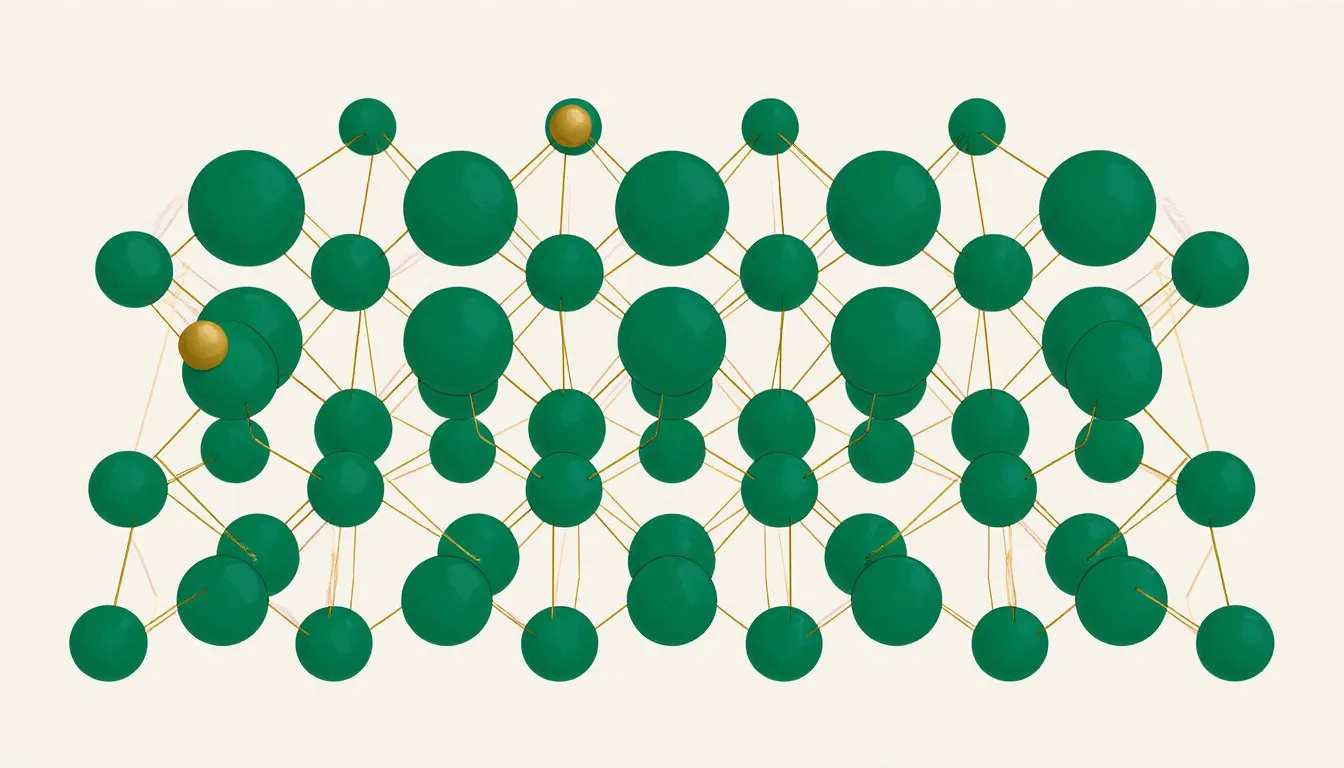
- Table salt, NaCl, is a compound but not a molecule. This one surprises people. There is no discrete “NaCl unit” floating around in a salt crystal. There is an endless three-dimensional lattice of alternating sodium and chloride ions, and the formula NaCl only tells you the ratio, one to one. Chemists call that a formula unit rather than a molecule, and the distinction matters as soon as you start counting.
- Helium is an atom and nothing else. It does not even bother pairing up with itself.
The ratio part of the compound definition deserves emphasis, because it is the tightest test we have. Water is always two hydrogens to one oxygen. Not usually, not on average: always, in every sample, from every source, whether it came from a glacier or a laboratory or a cloud. A substance whose composition can slide around continuously is not a compound. That fixed-ratio rule is what lets a chemist write a formula at all, and it is also the whole reason the differences between compounds and mixtures land where they do.
One more piece of vocabulary while we are being precise. An ion is an atom (or group of atoms) that has gained or lost electrons and therefore carries a charge. Sodium that has surrendered its outer electron is Na+, a cation. Chlorine that has accepted one is Cl-, an anion, and note the name change to chloride. That -ide ending is a signal: it tells you the atom is carrying negative charge. The difference between a cation and an anion turns up in almost every formula you will ever write, so it pays to have the terms cold early.
What Are the Main Types of Chemical Bonds?
Three types cover essentially all of ordinary matter: ionic, covalent, and metallic. They differ in one thing only, which is what the outer electrons end up doing.
- Ionic bonds: electrons are transferred. One atom loses, another gains, and the resulting opposite charges attract in every direction at once. Because the pull is non-directional, ionic compounds build extended crystal lattices rather than discrete units. Sodium chloride, calcium fluoride, and magnesium oxide all belong to this family. They pack their ions into different geometries, but the ionic bonding underneath is the same trade of an electron for a charge.
- Covalent bonds: electrons are shared between two nuclei, both of which pull on the same pair. The shared pair sits between the two atoms, so the bond points in a particular direction. That is why covalent substances form molecules with definite shapes and definite angles. Water, methane, oxygen gas, and every protein in your body are held together this way. The examples run from the simplest diatomic gases, two identical atoms splitting one pair of electrons between them, up to molecules with thousands of atoms in a fixed shape.
- Metallic bonds: electrons are pooled. Each atom in a piece of copper contributes its outer electrons to a shared population that belongs to no particular atom and moves freely through the whole sample. That pool is why metals conduct electricity and heat, why they are shiny, and why you can hammer them flat instead of shattering them.
The metallic case is usually taught with the “sea of electrons” picture: positive cores sitting in a fluid of mobile negative charge. It is a good picture and it predicts a lot. It stops being adequate once you ask why some metals are hard and others are soft, or why alloying copper with zinc makes brass tougher than either. For those questions the sea has to be replaced with a proper band model, but not today.
A fourth category gets mentioned in most courses and deserves a line here: intermolecular forces, including hydrogen bonding. These are attractions between whole molecules rather than bonds within them, and they are far weaker than the three above. They also explain a great deal about the everyday world, including why water is a liquid at room temperature when a chemically similar molecule, hydrogen sulfide, boils at around minus sixty degrees Celsius. Weak forces, huge consequences.
How Do Chemists Predict Which Kind of Bond Will Form?
They subtract. Every element has an electronegativity value, a number describing how strongly its atoms pull on shared electrons, and the difference between two elements’ values predicts what kind of bond they will make. Linus Pauling built the scale that almost everyone still uses, running from about 0.7 at the bottom to 3.98 for fluorine, the greediest element on the chart.
Sodium sits at about 0.93. Chlorine sits at about 3.16. The difference is roughly 2.2, which is enormous, and it tells you before you strike a single match that chlorine will simply take sodium’s electron rather than negotiate over it. Compare that with two chlorine atoms bonding to each other: the difference is exactly zero, neither one wins, and the electron pair sits squarely in the middle. That is a pure covalent bond.
Between those extremes lives the interesting territory. Hydrogen at 2.20 bonded to oxygen at 3.44 gives a difference of about 1.2. Too small for outright theft, too large for an even split, so the pair is shared but pulled toward oxygen, leaving the oxygen end of a water molecule slightly negative and the hydrogen ends slightly positive. That lopsidedness is called polarity, and it is responsible for water dissolving salt, for ice floating, and for a startling fraction of biology. For shapes more complicated than water you have to judge the whole molecule, not just its bonds, because a molecule can hold polar bonds and still come out non-polar overall when the geometry cancels them. Carbon dioxide is the standard case: two polar bonds pointing in exactly opposite directions, and they cancel.
Most first-year courses teach cutoffs: below about 0.4 call it non-polar covalent, between roughly 0.4 and 1.7 call it polar covalent, above about 1.7 or 1.8 call it ionic. Those numbers are a teaching convenience, not a law of nature, and the boundaries genuinely are fuzzy. Bonding is a continuum, and a compound sitting near a cutoff can behave partly like both. Close only counts in horseshoes and estimation, so use the cutoffs to make a prediction, then check the prediction against how the substance actually behaves.
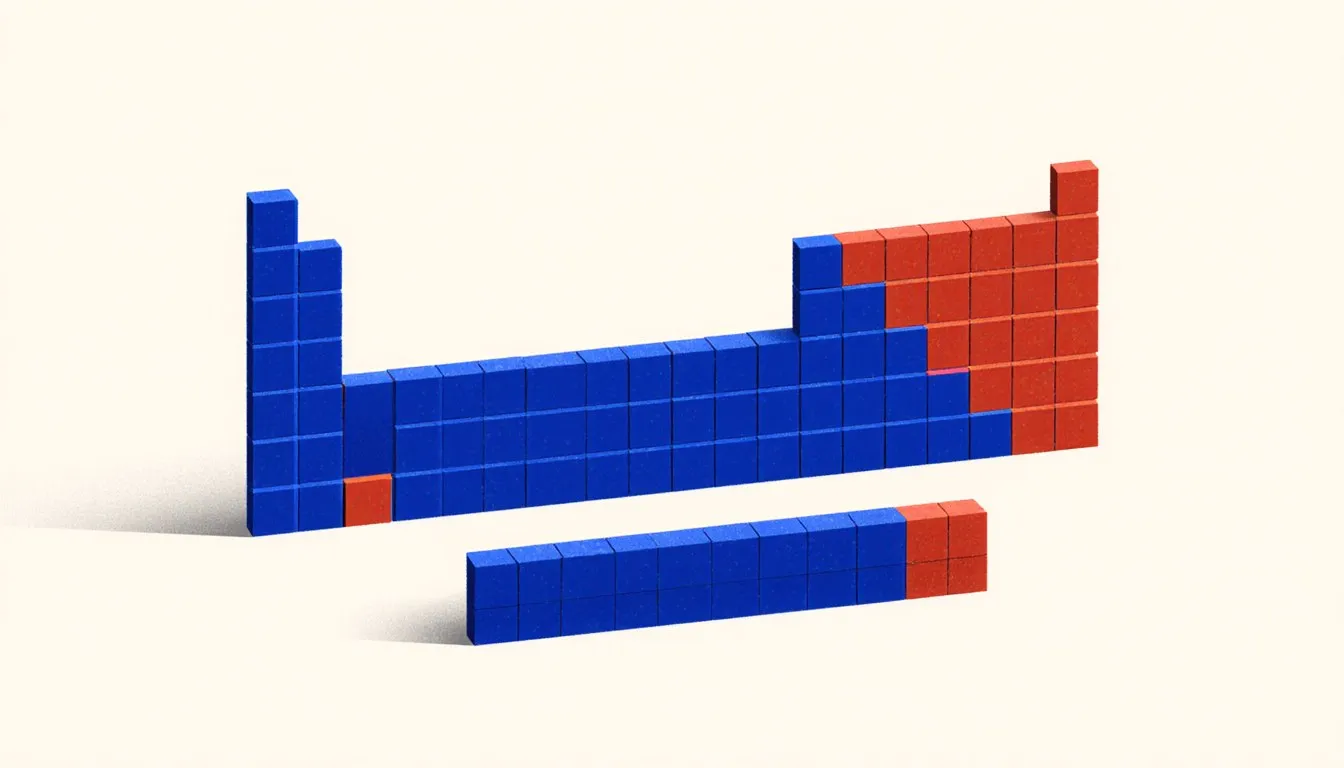
The periodic table makes all of this visual. Electronegativity climbs as you move right along a row and climbs as you move up a column, which puts the electron-hungry elements in the upper right and the electron-shedding metals in the lower left. Metal plus non-metal, drawn from opposite corners, usually gives you ionic. Non-metal plus non-metal, drawn from the same neighborhood, usually gives you covalent. You can predict a startling amount of chemistry with nothing but a table and the ability to subtract.
Alongside electronegativity sits the octet rule, the observation that main-group atoms tend toward eight electrons in their outer shell. It is a superb predictor and it has real exceptions: hydrogen and helium settle for two, boron is content with six, and elements from the third row down can accommodate more than eight. Learn the exceptions alongside the rule itself, because they are not rare curiosities. They include sulfur hexafluoride and phosphorus pentachloride, compounds that sit in every inorganic chemistry syllabus.
How Are Compounds Different From Mixtures?
In a compound, atoms are chemically bonded and something new exists. In a mixture, substances are merely in the same place and each keeps its own properties. Stir sand into sugar and you have a mixture: tedious to separate, but separable in principle with nothing but a sieve, patience, and no chemistry at all.
Three tests distinguish them reliably.
- Fixed composition. A compound has one, always. A mixture can be any proportion you like. Salt water can be barely brackish or nearly saturated and it is salt water either way. Sodium chloride is one sodium to one chlorine or it is not sodium chloride.
- Separation method. Mixture components come apart by physical means: filtering, evaporating, distilling, using a magnet. Compound components come apart only by chemical reaction, which usually means significant energy. You can boil off the water and recover your salt. You cannot boil sodium chloride back into sodium and chlorine; that takes electrolysis of the molten salt, and industry runs exactly that process at considerable expense.
- Energy signature. Making a mixture involves essentially no energy change. Making a compound releases or absorbs a measurable amount. Stirring sugar into tea produces no flame. Sodium meeting chlorine produces a flame you can see from across the lab.
Mixtures come in two flavors worth naming. A homogeneous mixture has uniform composition throughout, so a sample from the top matches a sample from the bottom; dissolved sugar in water qualifies, as does clean air at about 78 percent nitrogen and 21 percent oxygen. A heterogeneous mixture has visibly distinct regions: sand in water, oil and vinegar, granite. The line between homogeneous and heterogeneous is mostly a question of scale. It blurs around emulsions and colloids, and milk is the case that shows why: uniform in a glass, plainly not uniform under a microscope.
Alloys are the case that makes students argue, and they are right to. Brass is copper and zinc, and the proportions vary by grade, which by the fixed-composition test makes it a mixture. But the zinc atoms are sitting inside the copper’s crystal structure, sharing in the same pooled electrons, which does not feel like sand in sugar. The honest answer is that most alloys are solid solutions, a kind of mixture, and that a few specific metal-to-metal combinations do form true compounds with fixed formulas. Chemistry has edges, and pretending otherwise does nobody any favors.
How Do Compounds Get Their Names and Formulas?
Naming splits along the same seam as bonding: ionic compounds follow one set of rules, molecular compounds follow another, and knowing which set to use means knowing which kind of compound you are holding.
For an ionic compound, name the positive ion first, then the negative one with its ending changed to -ide. Sodium plus chloride gives sodium chloride. Magnesium plus oxide gives magnesium oxide. No prefixes appear, because the charges already fix the ratio: magnesium is reliably 2+ and chloride is reliably 1-, so magnesium chloride can only be MgCl2 and saying “magnesium dichloride” adds nothing. When a metal can carry more than one charge, and the transition metals cheerfully do, a Roman numeral resolves it. Iron(II) chloride is FeCl2. Iron(III) chloride is FeCl3. Different compounds, different colors, different reactions, and the numeral is the only thing telling them apart.
For a molecular compound, two non-metals sharing electrons, prefixes do the work because the ratio is not predictable from charges. Carbon and oxygen produce carbon monoxide, CO, and carbon dioxide, CO2, two substances with wildly different relationships to human lungs. Nitrogen and oxygen produce a whole family, including dinitrogen tetroxide, N2O4. The prefix on the first element is dropped when it would be “mono,” which is why nobody says monocarbon dioxide.
These conventions are maintained by IUPAC, the international body that decides such things, and their purpose is unglamorous and vital: a formula written in one country has to mean exactly the same substance in every other. A handful of names predate the system and survive because everyone already uses them. Water is the obvious one. Ammonia is another. IUPAC has not tried to make anyone say “dihydrogen monoxide” in a kitchen.
Going the other way, from name to formula, is where the practice work lives: balancing charges for ionic formulas, reducing to lowest terms, and working out empirical versus molecular formulas from percentage composition. The difference between ionic and molecular compounds is worth having straight before any of that, because choosing the wrong ruleset produces a formula that looks plausible and is simply wrong.
Why Do Compounds Behave Nothing Like Their Component Elements?
Back to the jar. Sodium is a soft grey metal you could cut with a butter knife, melting at about 98 degrees Celsius, so reactive it fizzes and can ignite on contact with water. Chlorine is a yellow-green gas that boils at about minus 34 degrees and will destroy lung tissue at concentrations you can smell. Their compound is a hard, colorless crystal that melts at 801 degrees Celsius, dissolves harmlessly in water, and is essential in your diet.
None of those properties was inherited. Every one of them is a consequence of the bond type, and you can read each property straight off the structure.
The melting point. To melt salt you have to overcome the electrostatic attraction between every ion and all of its neighbors. In the sodium chloride lattice, each ion is surrounded by six of the opposite charge. Those six are surrounded by six more, on and on through the crystal. There is no small unit to peel away. Melting it means dismantling the whole arrangement at once, which is why it takes 801 degrees. Molecular compounds melt far lower because you only have to separate whole molecules from each other, leaving their internal bonds untouched. That coordination number of six is a real structural fact with real consequences, and it varies from compound to compound.
The brittleness. Strike a salt crystal with a hammer and it cleaves along flat planes rather than denting. That happens because a hard enough blow slides one layer of ions over by a single position. Now sodium sits against sodium and chloride against chloride. Like charges repel, the layers fly apart, and you get a clean fracture face. Strike a copper sheet and it flattens instead, because the pooled electrons in a metallic bond just flow along with the displaced atoms and nothing ever finds itself next to a like charge. Malleability in chemistry comes down to exactly that difference in what the electrons are doing.
The conductivity. Solid salt does not conduct electricity, because its charged particles are locked in place. Melt it, or dissolve it in water, and it conducts beautifully, because now the ions can move and carry charge. That single behavior, insulating when solid and conducting when molten or dissolved, is one of the most reliable ionic fingerprints in the lab. A molecular compound like sugar dissolves happily and conducts nothing at all, because sugar dissolves as intact neutral molecules with no charges to move.
All three properties come from one structural fact, and this is the payoff of the whole subject: if you know what the electrons did, you can predict what the substance will do. That prediction runs the other way too. Hand a chemist an unknown white solid that melts around 800 degrees and conducts when molten, and they will tell you it is ionic before running a single further test.
What’s Actually Going On Inside the Atom That Makes Bonding Possible?
Only one of the three subatomic particles participates in chemistry, and it is the lightest one by an enormous margin. Bonding is entirely an electron affair.
An atom has a nucleus containing protons, each carrying one unit of positive charge, and neutrons, carrying none. Those two particles have nearly the same mass and together account for essentially all of the atom’s weight. Around the nucleus are the electrons, each with one unit of negative charge and about 1/1836 the mass of a proton. In a neutral atom the count of protons matches the count of electrons, and the proton count is the element’s identity: eleven protons is sodium and nothing else can be.
The nucleus is also astonishingly small compared with the atom around it, on the order of one hundred-thousandth of the total diameter. Almost all of an atom is the region the electrons occupy, which means when your hand rests on a table, electrons are meeting electrons. Protons never come near each other, and neither do the nuclei, which is exactly why chemistry can happen at room temperature while nuclear reactions cannot.
Not all electrons matter equally. The ones in the outermost occupied region, the valence electrons, do all the bonding. Inner electrons are shielded away and rarely participate in ordinary reactions. Sodium’s chemistry is the story of one electron out of eleven, and if you understand what that single electron does, you can predict how sodium behaves with essentially anything on the periodic table.
A caution on the picture in your head. If you are imagining electrons circling the nucleus like planets, that model is a century out of date and it will eventually mislead you, particularly about why bonds have the shapes they have. Electrons occupy regions of probability, not paths, and the electron cloud model is the honest replacement. It is harder to draw and it is correct, which is a trade you have to make sooner or later. Where atomic structure came from in the first place, and how many wrong models had to be built and discarded on the way, is a story worth reading on its own; the plum pudding model was a serious, careful, thoroughly reasonable idea right up until an experiment killed it.
Where Bonding Shows Up Next
Three bond types and one rule about outer electrons cover an absurd amount of the material world. Carbon’s willingness to form four covalent bonds and to bond to itself indefinitely produces the millions of organic compounds that make up every living thing, every plastic, and every fuel in your car. Ionic bonding builds the mineral kingdom, which is why quartz and calcite have flat faces and precise angles: the lattice underneath them is doing the same alternating-charge trick as salt, in more elaborate geometry. Metallic bonding gives you every wire in the wall.
The next time you salt a pot of water, you are watching the whole thing run backwards in miniature. Polar water molecules crowd around each ion at the crystal’s surface, negative ends toward sodium, positive ends toward chloride, and pull the lattice apart ion by ion. The bonds do not break so much as get outcompeted. Boil the water off and the ions find each other and rebuild the same cubic lattice they came from, which is why sea-salt crystals under a hand lens are little cubes.
Look at one under magnification sometime. Those right angles are the lattice itself, made visible. The same alternating arrangement of sodium and chloride that assembled in the jar is stacked something like ten million ions along each edge, and that much repetition is what carries an atomic pattern up to the size of a grain you can pinch between two fingers.
Nora Whitfield
Staff Writer
Nora Whitfield taught high-school chemistry and physics for twenty-eight years, and she has never once answered "when will I use this?" with a sigh. She believes any honest question about how the world works deserves an answer that is both correct and actually understandable.