
How Sunlight Becomes a Fox, and How Little of It Survives the Trip
Food chains and food webs run on sunlight that shrinks at every bite. How trophic levels, decomposers and the ten percent rule shape a whole ecosystem.
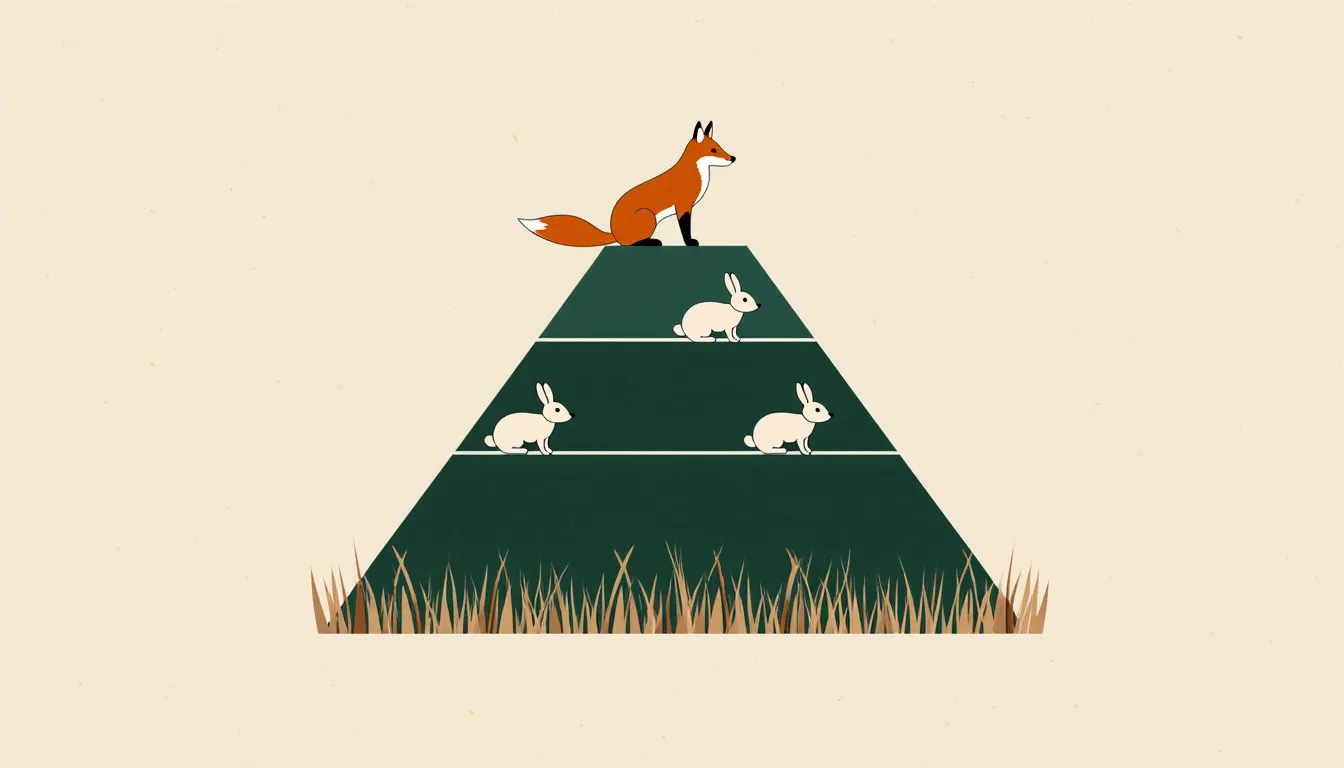
Follow one packet of sunlight into a meadow and watch what happens to it. A blade of grass catches it and stores maybe one percent of the energy that landed on it. A rabbit eats the grass and keeps about a tenth of what the grass banked. A fox eats the rabbit and keeps about a tenth of that. By the time the energy is powering a fox’s legs, it has been through three sets of books and there is almost nothing left of the original deposit. That accounting, repeated across every organism in a habitat, is what food chains and food webs describe: the route energy takes through a place, and how much of it survives each handoff.
Everything else in this subject follows from that shrinkage. It explains why predators are rare and grass is everywhere, why a food web is shaped like a pyramid instead of a rectangle, why chains stop after four or five links, and why pulling one species out of a web can knock over species that never touched it. Below is the whole map, from the first blade of grass to the fungi that eventually take the fox apart.
What is a food chain?
Grass, rabbit, fox, and then the fungi and bacteria that break down whatever the fox leaves behind. Four steps, one line, arrows running from the eaten to the eater. That is a food chain: a single traced path showing how energy and matter move from one organism to the next in a habitat.
The arrows are the part students get wrong, and they get it wrong for a sensible reason. Asked to draw “rabbit eats grass,” most people point the arrow from the rabbit at the grass, because that is the direction the eating happens. The arrow in a food chain points the other way, from grass to rabbit, because it is tracking the energy, and the energy travels out of the grass and into the rabbit. Say “is eaten by” out loud as you draw each arrow, and the head lands on the eater every time. Once that clicks, a food chain stops being a picture of animals and becomes a picture of a transaction.
A chain is a deliberate simplification, and it helps to say so out loud. No fox in England eats only rabbits. Foxes take voles, beetles, earthworms, windfall apples, blackberries, and, in town, whatever is in the bin. No rabbit eats only one species of grass. The chain grass to rabbit to fox is a true statement about one possible route, drawn the way you would draw a single road on a map of a city with a thousand roads. It is honest as far as it goes, and useful precisely because it is small enough to hold in your head.
What a chain does well is show the direction of travel and the number of steps. Count the steps and you have counted the transfers, and each transfer is where the interesting losses happen. What a chain does badly is show what actually happens when something goes wrong, because in a real habitat almost nothing has only one predator or only one food.
What is a food web, and how is it different from a food chain?
A food web is many food chains laid over one another, sharing organisms where they cross. The single distinction worth memorising: a chain is one path, a web is all the paths at once.
Take that meadow again and stop pretending. The rabbit is eaten by the fox, but also by a buzzard, a stoat, and, when it is very young, a crow. The fox eats the rabbit, but also the vole, and the vole eats seeds that the rabbit never touches. Earthworms pull dead grass down into the soil and are then eaten by a badger that also eats wasp grubs and, in autumn, a great deal of fruit. Draw all of that and you get a tangle with dozens of arrows, most organisms appearing in several chains at once, and a few species sitting at junctions where a startling number of arrows meet.
The crossings are what give a habitat somewhere to go when one food source fails. If the rabbits crash in a bad winter, the fox switches to voles, earthworms, beetles, and the windfall fruit under the hedge, and comes out of the season thin but alive. Every extra arrow you can honestly draw into an animal is another bad winter it can sit through. If you want the two laid out side by side, definition against definition, there is a full breakdown of the difference between a food chain and a food web.
One practical note for anyone drawing a web for a class or a project: the web is only ever as good as the feeding relationships you can actually justify. An arrow drawn in because that corner of the page looked empty is decoration, and it will quietly make the rest of the diagram wrong. Every arrow should be something you could defend if asked “how do you know that one eats that one?”
What are trophic levels?
A trophic level is a position in the chain, counted by how many eating steps separate an organism from the sunlight. Producers are level one, whatever eats them is level two, and so on up. The word comes from the Greek for nourishment, which is a rare case of a technical term meaning exactly what it says.
- Producers (autotrophs): organisms that build their own food from inorganic raw materials. Green plants, algae, and cyanobacteria do it with sunlight, water, and carbon dioxide. Every joule in the meadow entered through them.
- Primary consumers: the herbivores that eat producers. Rabbits, caterpillars, cattle, aphids, zooplankton grazing on algae. There is a longer survey of examples of primary consumers that goes through them habitat by habitat.
- Secondary consumers: animals that eat primary consumers. A shrew eating a caterpillar, a ladybird eating aphids, a robin eating an earthworm.
- Tertiary consumers: animals that eat secondary consumers. The fox eating the shrew, the sparrowhawk eating the robin. The level has more variety in it than people expect, and examples of tertiary consumers is where that gets its full treatment.
- Apex predators: animals with no significant natural predator of their own once they are adult. Orcas, adult saltwater crocodiles, large eagles. Apex describes a position in the web, and an animal holds it by having nothing above it, which is a fact about its neighbours as much as about itself.
Two honest complications, because leaving them out makes the neat version harder to trust later. The first is that producers are not always plants. Around hydrothermal vents on the deep sea floor, where no sunlight has ever reached, bacteria build organic matter using the chemical energy in hydrogen sulphide instead of light. Those chemosynthetic bacteria are producers in every sense that matters: they are the entry point for energy into that community, and tube worms and clams live on what they make.
The second complication is that most animals refuse to stay on one level. A badger eating earthworms is a secondary consumer that afternoon and a primary consumer the moment it starts on the blackberries. A fox eating a rabbit sits at level three; a fox eating a stoat that ate a shrew that ate a beetle sits at level five. Ecologists handle this by giving omnivores an average, fractional trophic level rather than pretending they pick a lane. Humans land somewhere just above level two, closer to a pig than to a wolf, which surprises people who think of themselves as apex anything.
What job do decomposers do in the web?
Decomposers break dead organisms and waste back down into simple chemical building blocks that producers can take up and use again. Without them the meadow would run out of raw material in a few decades and then choke on its own dead.
The workforce splits into two groups that get muddled constantly. Detritivores are animals that eat dead material and digest it internally: earthworms, woodlice, millipedes, dung beetles, and, in a stream, the caddisfly larvae shredding fallen leaves. True decomposers, mostly fungi and bacteria, work from the outside in, secreting enzymes onto dead matter and absorbing what dissolves. Both end up returning the same nutrients to the soil by different routes: the earthworm grinds its leaf litter in a muscular gizzard, and the fungus digests the same leaf where it lies and absorbs what comes off it.
Here is the part worth slowing down for, because it is the single idea that turns a food web from a diagram into a working system. Energy travels one way through a web and leaves at the far end as heat, while matter keeps going round in a loop. The nitrogen in the fox’s muscle was in a rabbit last month, in a grass blade the month before, and in the soil before that, and once the fungi have finished with the fox it will be back in the soil as ammonium and nitrate. The same atoms of phosphorus, calcium, and carbon go round the loop again and again, and decomposition is the return leg. A grass root takes its nitrogen up as ammonium and nitrate ions dissolved in soil water, which is what a rabbit eventually becomes once the fungi and the soil bacteria have worked through it, and that conversion has a good deal of chemistry of its own.
Decomposers also sit outside the tidy pyramid, and diagrams that hang them off the end of the chain like a full stop are misleading. Fungi and bacteria feed on dead material from every level at once: dead grass, dead rabbit, dead fox, and the waste of all three. If you drew them accurately they would have arrows coming in from everywhere, which is why textbook diagrams cheat and put them in a box at the bottom.
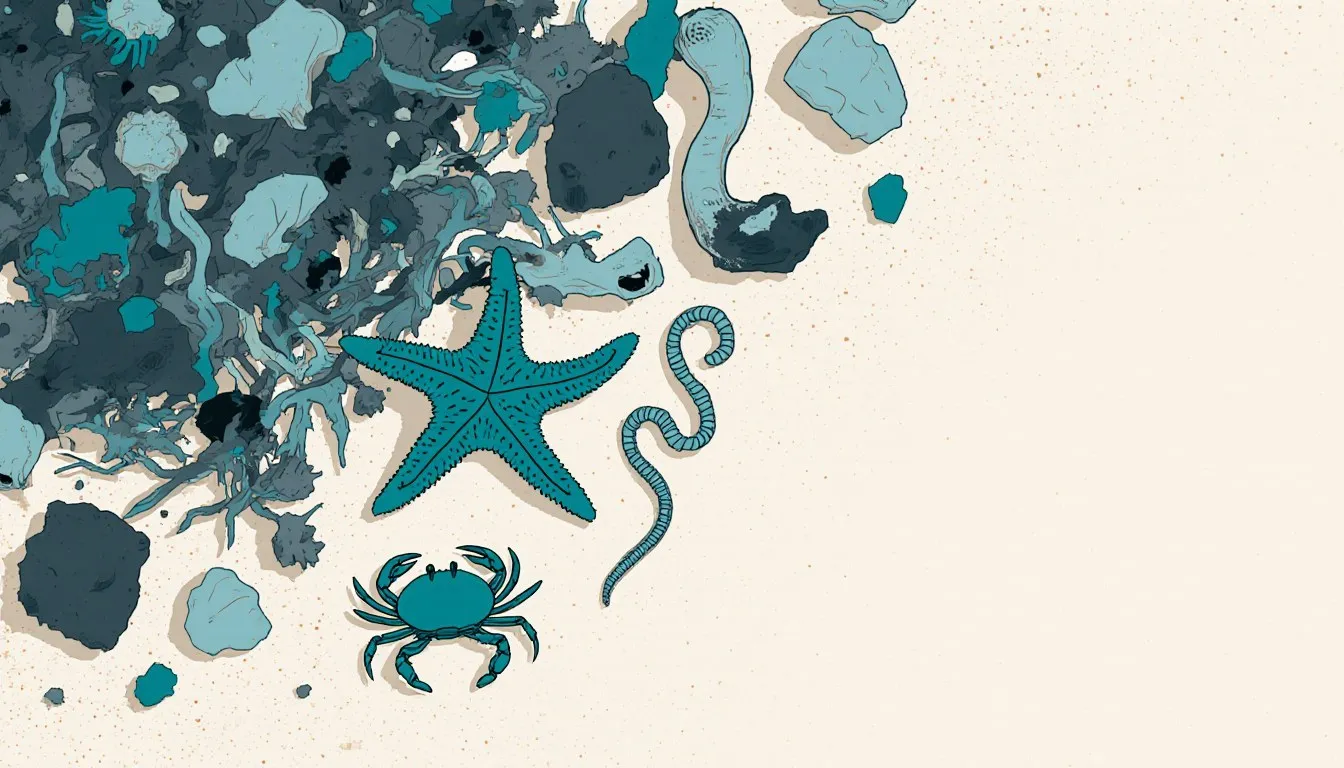
Where this gets genuinely strange is at sea. There is no soil, so the dead do not stay put: they sink. A continuous drift of dead plankton, faecal pellets, and shed body parts falls through the water column, a flux that oceanographers call marine snow, feeding bacteria and scavengers all the way down and reaching the sea floor as a thin rain of nutrients. The specialists living on that fall are worth a look in their own right, in a fuller account of the decomposers of the ocean, because the deep sea is the one place where the recycling crew is most of the community.
Why does energy shrink at every link?
Because most of the energy at any level is spent staying alive, and spent energy leaves as heat. The rough working figure is that about ten percent of the energy at one trophic level makes it into the next. That is the ten percent rule, and it is the reason food webs are pyramid shaped.
Follow a rabbit’s budget and the losses stop being abstract. The rabbit does not eat every blade of grass in its patch, so some of the energy is never picked up at all. Of the grass it does eat, a good fraction passes through undigested and comes out the far end, still full of chemical energy but no longer the rabbit’s problem. Of what it does absorb, most gets burned in respiration to power a heartbeat, a body temperature, a run from a fox, and the constant repair work of being alive. All of that ends as heat lost to the air. Only what is left over builds new rabbit tissue, and only new rabbit tissue is available to the fox. Ten percent is generous, in fact. Measured ecological efficiencies commonly fall somewhere between about five and twenty percent depending on the animals involved, and ten is the teaching average sitting in the middle.
Warm-blooded animals do worst. A mammal or a bird spends an enormous share of its intake on holding body temperature steady, which is why a cow converts grass into beef so wastefully and why fish farming gets more food out of the same feed. A caterpillar, which lets the weather decide its temperature, keeps a much larger fraction of what it eats. The second law of thermodynamics collects its fee at every transaction, and it collects in every habitat on the planet: every joule spent on a heartbeat, a shiver, or a sprint leaves as heat and never re-enters the web.
Even the first step is lossy. A leaf captures on the order of one percent of the sunlight energy falling on it over a season, and rarely more than a few percent even under the best conditions. The rest is reflected, passes through, or lands on soil. Every food chain on Earth is therefore built on a very small slice of a very large supply.
Two consequences fall straight out of the arithmetic. The first is the shape. If each level holds roughly a tenth of the energy of the level below, then drawing energy content as a stack of bars gives you a pyramid every time, wide at the producers and narrow at the top. The taper is a measurement, drawn to the numbers the field data gives you. The second is length. Start with a large amount of energy in the grass, take a tenth four times over, and there is not enough left to support a viable population of anything bigger. Real food chains almost never run past four or five links, and the ones that do are in habitats where the producers are extraordinarily productive. Raymond Lindeman set out this trophic-dynamic way of accounting for a lake community in the 1940s, and it has been the backbone of the subject since.
One caution before you trust the pyramid too far. Units matter here, and I have seen more marks lost to units than to arithmetic. A pyramid of energy always narrows upwards. A pyramid of biomass, which measures the mass of living tissue present at one moment, can come out upside down in the open ocean, where the phytoplankton weigh less at any instant than the zooplankton eating them. The producers there reproduce so fast that a small standing crop feeds a much larger consumer population, the way a small bakery working flat out can feed a queue that weighs more than the bakery. Total up what those phytoplankton hand upwards across a whole season and the pyramid stands upright again, with room to spare. The scales only ever caught the producers mid-shift, between one division and the next.
What does a food chain look like in different habitats?
The same logic runs everywhere, producer to consumer to predator to decomposer, but the amount of energy entering at the bottom changes wildly, and that changes everything above it.
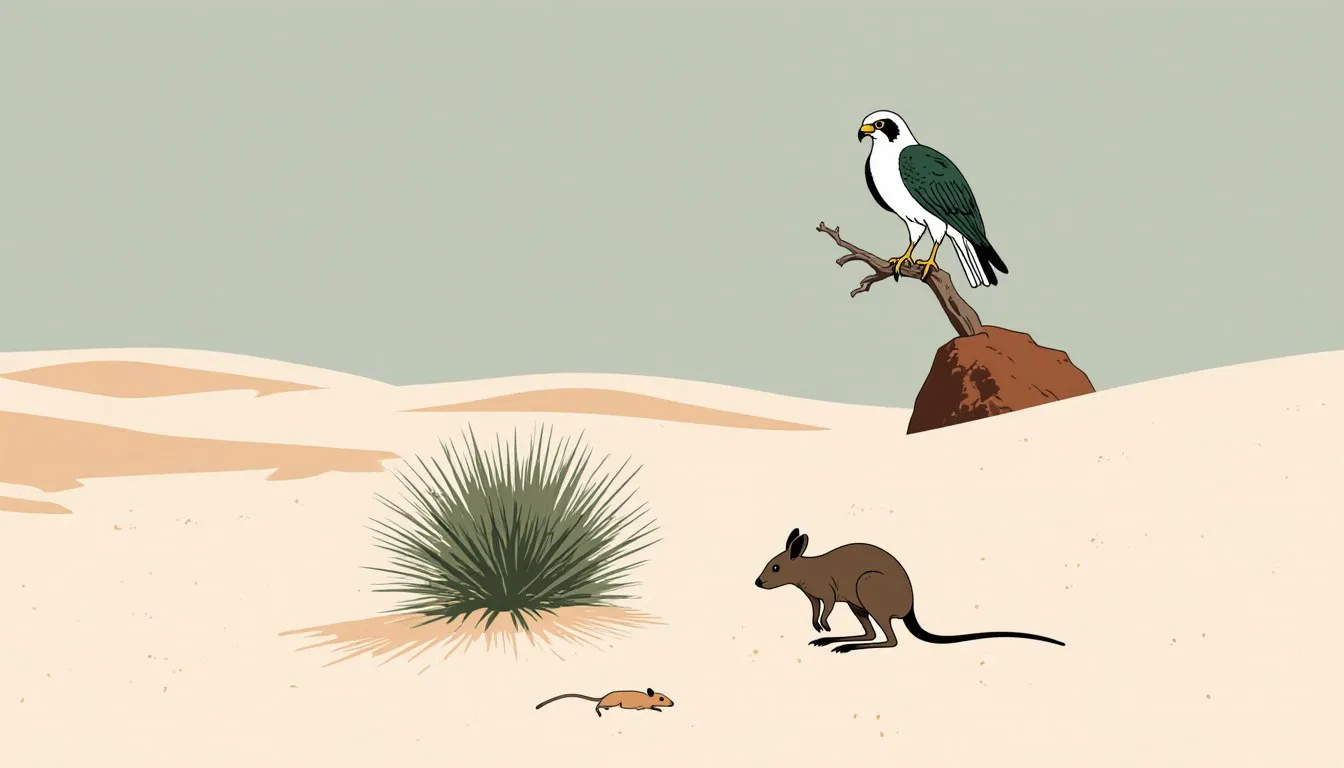
In a desert, sunlight is abundant and water is not, so the producers are sparse, slow, and heavily defended with spines and waxes. Sparse producers mean small consumer populations spread thin, which is why desert predators tend to be small, patient, and nocturnal. The chains are short and the animals are widely spaced. A kit fox and a sidewinder are working the same few kilometres of sand for the same scarce kangaroo rats, and the whole community, drawn out properly in a full desert food chain, still fits on a page with room to spare. A desert web carries a fraction of the arrows a hedgerow does, and every one of them runs through an animal built to go a long time between meals.
The tundra runs into a different limit. There is plenty of water, but it is frozen for most of the year and the growing season is a matter of weeks. Lichens and low shrubs feed caribou and lemmings, which feed arctic foxes, wolves, and snowy owls. The twist is at the decomposer end: cold slows fungi and bacteria to a crawl, so dead material piles up as peat instead of being recycled, and the nutrients sit locked in the ground rather than circulating. So the tundra runs its web on a slow, half-frozen bank account, and a full tundra food chain is worth reading with that in mind. Dig into the peat and you are looking at organic matter that has been waiting decades for warm enough weather to rot.
The ocean inverts the picture on land. Its producers are microscopic and drifting, and they turn over in days rather than seasons, so a small mass of phytoplankton supports a startling weight of consumers above it. Chains there also tend to run longer than on land, which is how you end up with five or six links between a diatom and a killer whale. That is the inverted pyramid from the last section, out in the field, and a complete ocean food web is where those crossings get drawn out in full, alongside a single-path version and a diagram of the ocean food chain for anyone who thinks better in pictures. Weigh everything alive in a cubic metre of the North Atlantic in spring and the plants come out lighter than the animals grazing on them, which would be impossible on land and is routine at sea, because a diatom can divide in a day and an oak cannot. Trace one path down from an orca and stop at each link to ask how fast that organism reproduces; the reproduction rate at each step is what keeps the level above it fed.
Rainforest is the opposite extreme: constant warmth, constant water, and more energy entering per square metre than almost anywhere on Earth. The productivity goes into an enormous standing mass of living tissue and an equally enormous number of species, most of them specialists eating one or two things. The rainforest food web, and the closer regional view in a tropical rainforest food web, take that specialisation apart species by species. Decomposition runs so fast that leaf litter is stripped within weeks and the nutrients go straight back up into the trees rather than accumulating in the soil, which is why cleared rainforest soil disappoints farmers so quickly. Most of the fertility in that forest is standing up in the wood, and felling the wood carries it off.
What happens when a strand of the web breaks?
Sometimes nothing much, and sometimes the whole structure rearranges itself. What decides it is the number of arrows that ran through whatever went missing. A scarce predator with twenty arrows through it takes more of the web with it than a common one with two.
Robert Paine tested this directly on a rocky shore on the Washington coast in the 1960s by doing something wonderfully simple: he prised the starfish off a stretch of shoreline and threw them into the sea, then kept doing it, and watched. The starfish had been eating mussels. Without them, the mussels spread across the rock and crowded out nearly everything else, and the number of species living there fell sharply. One predator, never especially numerous, had been holding the diversity of the whole shore in place. Paine called such a species a keystone, after the wedge-shaped stone at the top of an arch that carries no more weight than its neighbours but drops the arch when you pull it out.
The pattern shows up in habitat after habitat. Sea otters eat sea urchins; urchins eat kelp. Where otters were hunted out for their fur, urchin numbers rose and grazed the kelp forests down to bare rock, taking the fish, invertebrates, and shelter that lived in the kelp along with them. Where otters returned, so did the kelp. Effects that travel down through levels like that are called trophic cascades, and the wolves returned to Yellowstone in 1995 are the most photographed example, credited with reducing elk browsing and letting willow and aspen recover along the rivers. Worth saying plainly, since the story circulates in a much tidier form than the data support: ecologists still argue about how much of that recovery the wolves caused, with drought, bears, cougars, and beaver activity all in the mix. The browsing and streamside-vegetation records support a cascade running from wolves through elk to willow, while the popular telling, in which wolves redirected the rivers on their own, runs well past what those measurements can carry.
Adding a strand can be as disruptive as cutting one. Cane toads were released in Queensland in 1935 to control a beetle in the sugar cane, failed at that job, and spread across northern Australia carrying a potent toxin that native predators had never encountered. Quolls and goannas that ate them died, and the effects moved outward from there. Zebra mussels arriving in the Great Lakes in ballast water filtered the water so thoroughly that they changed which parts of the web the energy reached, pulling it out of the open water and down onto the bottom.
Pollutants use the web too, and they travel the same routes energy does. A fat-soluble contaminant that an organism cannot excrete accumulates in its tissues over a lifetime, and a predator eating a hundred contaminated prey inherits the total. The concentration therefore climbs with every level, which is why long marine chains have so much of the trouble. Two separate processes are running there, one inside a single animal across its lifetime and one climbing the levels, and the difference between bioaccumulation and biomagnification is worth having straight before you read anything about mercury in tuna.
What keeps a food web’s populations in balance?
Feedback, mostly. Predation, competition, disease, and the plain limits of food and space push back harder as a population grows, and that pushback is what stops any one species from running away with the web.
The classic picture comes from the Hudson’s Bay Company’s fur trading records, which tracked lynx and snowshoe hare pelts for well over a century. Both populations rise and fall on a cycle of roughly nine or ten years, with lynx numbers trailing hare numbers, exactly the lag you would expect if predators boom after their prey does and crash after their prey crashes. It is the tidiest natural demonstration of predator-prey feedback anyone has, and it is tidier than the underlying biology: the hares are limited by their own winter food supply as well as by lynx, so the cycle has at least two engines.
Balance is a poor word for what results, though it is the word everyone uses. Populations in a working web oscillate constantly rather than settling on a number. What a healthy web has is a tendency to return: a bad year for voles is followed by a good one, and the voles are still there to have it. Some of what regulates numbers depends on how crowded a population already is, and some of it, a late frost or a flood, arrives without any regard for how many individuals are present. The distinction matters more than it sounds like it does, and it is worked out properly in a comparison of density-dependent and density-independent factors.
There is also the question of when in life the dying happens. A cod releasing millions of eggs loses nearly all of them in the first weeks; an elephant produces one calf at long intervals and most calves reach adulthood. Both strategies work, and both leave a distinctive signature in the survival data, which is what the types of survivorship curve are a way of reading.
Why does the shape of a food web matter?
Because shape is what makes a web survivable and a chain fragile. In a chain, every link is load-bearing, and removing any one of them cuts everything above it off from its energy supply. In a web, most species have alternatives, and the loss of one food source reroutes rather than severs.
Two features of the shape carry most of that resilience. The first is redundancy: several species doing roughly the same job at the same level, so that when one fails another takes up the work. A meadow with six species of grass keeps feeding rabbits through a drought that kills two of them. The second is connectance, how densely the arrows are packed. A web where most consumers are generalists has more routes for energy to take, and losing an arrow leaves the traffic somewhere to go. A web of specialists, each locked to one food, has a great many single points of failure, which is part of why species-rich rainforests can be surprisingly brittle: enormous diversity, but a lot of it made of species that eat exactly one thing.
This is why an ecologist looking at a web reads it as a diagnostic. How many trophic levels does it still support? Are the top levels occupied at all, or has fishing and hunting flattened it? Are the arrows spread widely or funnelled through two or three species that everything depends on? A habitat that has lost its longest chains, so that nothing lives above the second consumer level, is telling you that the energy base has shrunk or the top has been removed. A web that has quietly narrowed to a few dominant species is a web where the next loss will matter far more than the last one did.
The map ends here, but the observing does not have to. Go outside and pick one organism, any one, a blackbird on a lawn, a snail on a wall, the moss in a pavement crack, and try to draw three arrows leading into it and three leading out. You will get stuck within a minute or two, and the place you get stuck is the interesting bit: it is a real question about a real animal in a real place, and somebody has probably measured it. That is roughly how the whole field started.
Nora Whitfield
Staff Writer
Nora Whitfield taught high-school chemistry and physics for twenty-eight years, and she has never once answered "when will I use this?" with a sigh. She believes any honest question about how the world works deserves an answer that is both correct and actually understandable.