Every Contact Leaves a Trace: How Forensic Science Answers What Happened
Forensic science and investigation, explained by a teacher: the transfer principle, the major branches, how evidence travels from scene to courtroom.
A burglar wearing gloves still leaves the scene carrying it with him. Carpet fibers in the tread of his boots, brick dust in the weave of his sleeve, a smear of his own skin cells on the window latch where the glove rode up. Forensic science is the work of finding that material and making it testify. The chemistry, biology, and physics involved are the ordinary kind, aimed at one stubborn question: what actually happened here?
There is no substance in a forensic lab that a university chemistry department does not also have. The gas chromatograph that separates accelerants in a fire debris sample is the same instrument that separates flavor compounds in coffee. Two things differ: the question being asked, and the standard of care required to answer it. That second one is heavy. The answer gets read aloud to twelve people, and those twelve then decide what to do with a human life.
What is forensic science, really?
Forensic science is any science applied to a legal question. That is the whole definition, and its breadth is the point. If a court needs to know whether a signature was forged, whether a soil sample came from a particular field, whether a hard drive was wiped on Tuesday or Thursday, whether a body was moved after death, there is a discipline that can address it. In every one of those cases the discipline is chemistry or biology or physics or statistics wearing a job title.
The word itself comes from the Latin forum, the public square where Roman legal matters were argued. Forensic means “pertaining to the court,” which covers far more ground than crime does. A structural engineer analyzing why a walkway collapsed is doing forensic work. So is the accountant reconstructing a fraudulent ledger. Crime is simply where the public’s attention lands.
A forensic scientist runs the same techniques as a university lab, under three constraints that would make most researchers itch. You usually cannot repeat the experiment, because the sample is finite and consuming it in analysis destroys it. You did not design the sampling; whatever the scene handed you is what you get. And you must be able to account for that sample’s location and handling at every moment since it was collected, which is a documentation burden no ordinary lab imposes.
Definitions get their own room elsewhere: a closer look at what forensic science is works through the terminology and where the boundaries sit. Here we are drawing the map of the whole field.
Why can’t a criminal just leave no trace?
Because two surfaces cannot touch without exchanging material. That is the transfer principle, and every branch of forensic science is a consequence of it.
Press your palm against a clean window. You have deposited a film of water, salt, amino acids, and skin oils in the exact pattern of your friction ridges. You have also picked up dust, whatever cleaning residue was on the glass, and possibly a few fibers. Material moved in both directions. Neither of you had a choice about it. At the scale where surfaces actually meet, nothing is smooth. Both sides are landscapes of ridges, pores, and loose particles. Press them together and those landscapes interlock, and each one sheds into the other.
The principle is named for Edmond Locard, the French criminalist who built one of the first police laboratories in Lyon in the early twentieth century and who argued that the physical evidence of a crime does not forget, does not get confused, and does not lie the way a witness can. Locard’s exchange principle in forensic science is worth reading on its own, both for his fuller argument and for the cases that have since tested it.
Physics guarantees the transfer. Time, weather, and ordinary movement then decide how much of it is still there when someone comes looking, and the honest answer is usually not much. A fiber shed onto a jacket in a struggle has maybe a few hours of high probability before ordinary movement shakes most of it loose. Glass fragments in hair survive a shampoo poorly. Rain washes a footwear impression out of soil in an afternoon. Skin cells on a doorknob degrade in warmth and humidity. So the working version of the principle is more sobering than the slogan: the trace was definitely created, and it is probably already gone. Every hour between the event and the first responder’s arrival is an hour of evidence quietly leaving.
This is why scene response is a race, and why the least glamorous person at a homicide, the officer standing in the rain keeping people out of a taped-off area, is doing something scientifically indispensable. Every additional person who walks through a scene deposits their own trace and carries away someone else’s.
What are the major branches of forensic science?
The disciplines sort naturally by the question each one is built to answer. That is a more useful organizing principle than the usual alphabetical pile, because it tells you which specialist a piece of evidence should go to.
- Forensic biology: who was here? Blood, semen, saliva, hair, and skin cells get identified as biological material and then typed for DNA. This is the branch that produces the identifications people think of as definitive.
- Forensic chemistry: what is this substance? Unknown powders, suspected drugs, accelerants from fire debris, explosive residues, paint chips from a hit-and-run. Chemists separate mixtures and match spectra against reference libraries.
- Forensic toxicology: what was in this person’s body, and how much? Drugs, alcohol, poisons, and their metabolites in blood, urine, liver tissue, hair. Modern instruments find almost anything, so the toxicologist’s hard problem is interpretation. A concentration measured at death does not translate simply into impairment during life.
- Forensic pathology: how and when did this person die? A medical examiner or coroner’s pathologist performs the autopsy, determines cause and manner of death, and reads injuries for the mechanism that produced them.
- Forensic anthropology: who was this, from bone alone? When soft tissue is gone, the skeleton still carries age at death, biological sex, stature, ancestry estimates, healed fractures, and sometimes the marks of the injury that killed.
- Forensic odontology: dental identification. Teeth survive fire and decomposition better than nearly anything else in the body, and dental records are widely kept, which makes odontology genuinely strong for identifying remains. Bite-mark comparison on skin is a different matter, and a contested one, which we will get to.
- Forensic entomology: how long has this body been here? Blowflies find remains within minutes and lay eggs on a schedule governed by temperature. Rear the larvae, know the local weather, and you can work backwards to a colonization time. The insects work like a thermometer with a calendar attached, and the calendar has a habit of starting late. Flies cannot reach a body that is sealed indoors, wrapped, or buried, so colonization can lag death by days. The reconstruction also leans on weather data from a nearby station rather than from the spot itself. What entomology dates is the arrival of the first flies, and the distance between that and the death is the part an examiner has to argue for.
- Digital forensics: what did this device record? Deleted files, browser histories, location data, message timestamps, network logs. This is now the fastest-growing branch by caseload, because almost every crime involves a phone even when it involves nothing else technological.
- Firearms and toolmark examination: did this tool make this mark? Rifling striations on a bullet, breech-face impressions on a cartridge case, a pry bar’s edge in a door frame.
- Questioned document examination: who wrote this, and has it been altered? Handwriting, ink chemistry, paper, printer artifacts, indented impressions from the sheet above.
Notice how few of those are single-discipline questions in practice. A suspicious death might involve a pathologist for cause, a toxicologist for what was in the blood, an entomologist for the interval since death, a biologist for the DNA under the fingernails, and a digital examiner for the phone in the victim’s pocket. Each answers a narrow question well. The investigation is what assembles them, and the assembly is where reasoning errors live.
How do investigators read a crime scene itself?
Before any of that lab work, someone has to decide what the scene contains and get it out intact. Scene processing runs in a fixed order for a reason, and the order is essentially a list of what destroys what.
First comes securing the perimeter and establishing a single controlled path in and out, so that the traffic through the scene is logged and its contamination accounted for. Then documentation, overall photographs before anything moves, then mid-range, then close-ups with a scale in frame, plus notes and a sketch with measurements. Then the fragile and the transient: an impression in dust, a wet stain about to dry, a smell of solvent that will be gone in an hour. Only then does anyone start lifting, swabbing, and packaging.
My students always want to skip to the swabbing. That impulse costs real cases. Photograph first, always, because photography is the only step that takes nothing away.
Packaging has its own chemistry. Biological evidence goes into paper, not plastic, because plastic traps moisture and moisture grows the bacteria that degrade DNA. Fire debris goes into sealed metal cans, because the volatile compounds you are looking for will diffuse straight through a plastic bag. Wet items are dried before storage. Each of those rules is the difference between a sample that yields a profile and a sample that yields mold.
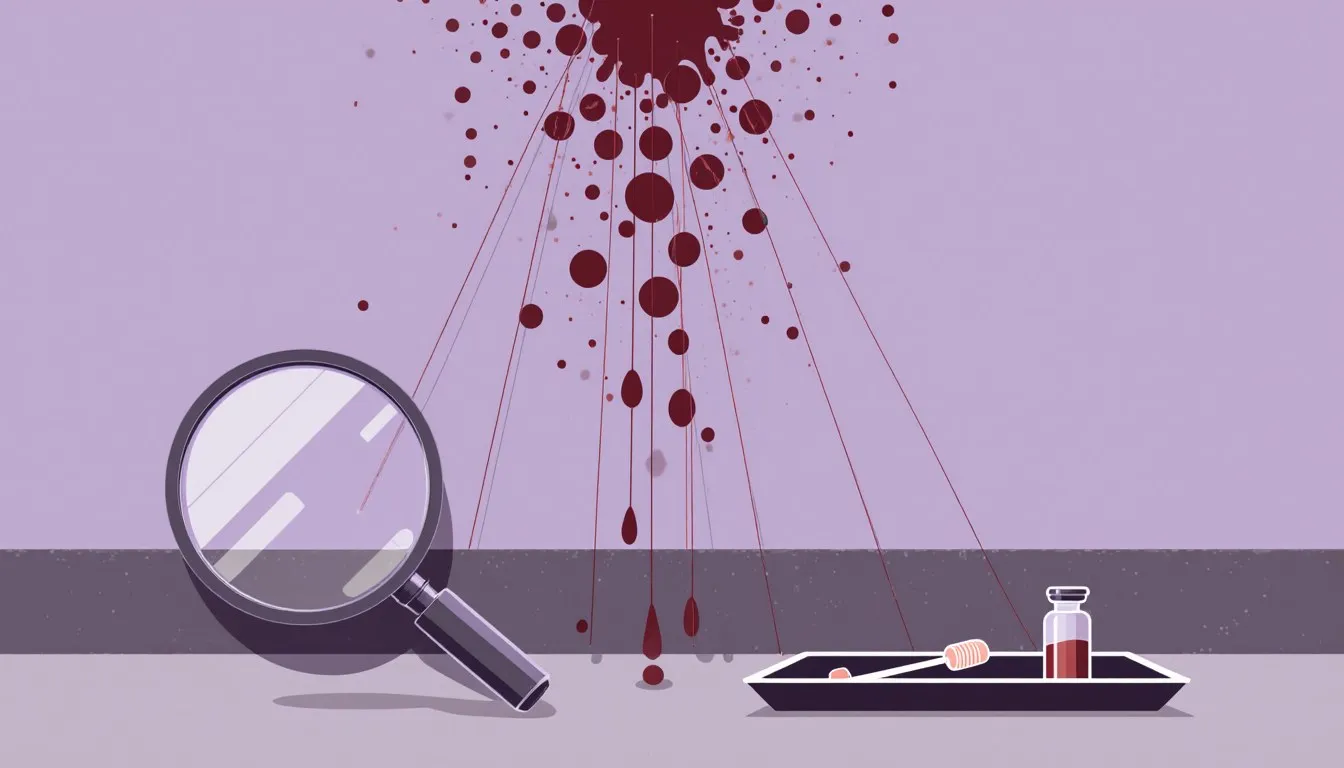
A large part of what a scene offers is pattern evidence: information carried by the shape and distribution of something rather than by its chemical composition. Footwear impressions and their wear patterns. Tire tracks. Glass fracture patterns, which record which side an impact came from and, when there are two holes, which one came first, because a later crack stops when it meets an earlier one. Fire burn patterns that point back toward an origin. And bloodstains, whose size, shape, and distribution encode the direction and rough energy of whatever put them in the air. Reading spatter is a discipline in itself, with real trigonometry behind it, and if that is the part that interests you, bloodstain pattern analysis is where the trigonometry gets worked out properly, along with the evidence gathering technique that gets a stain measured and documented before anyone cleans the wall.
Pattern evidence is where the field is simultaneously at its most visually persuasive and its most epistemically fragile, which is a combination worth holding onto for the section on limits.
How does a fingerprint actually identify someone?
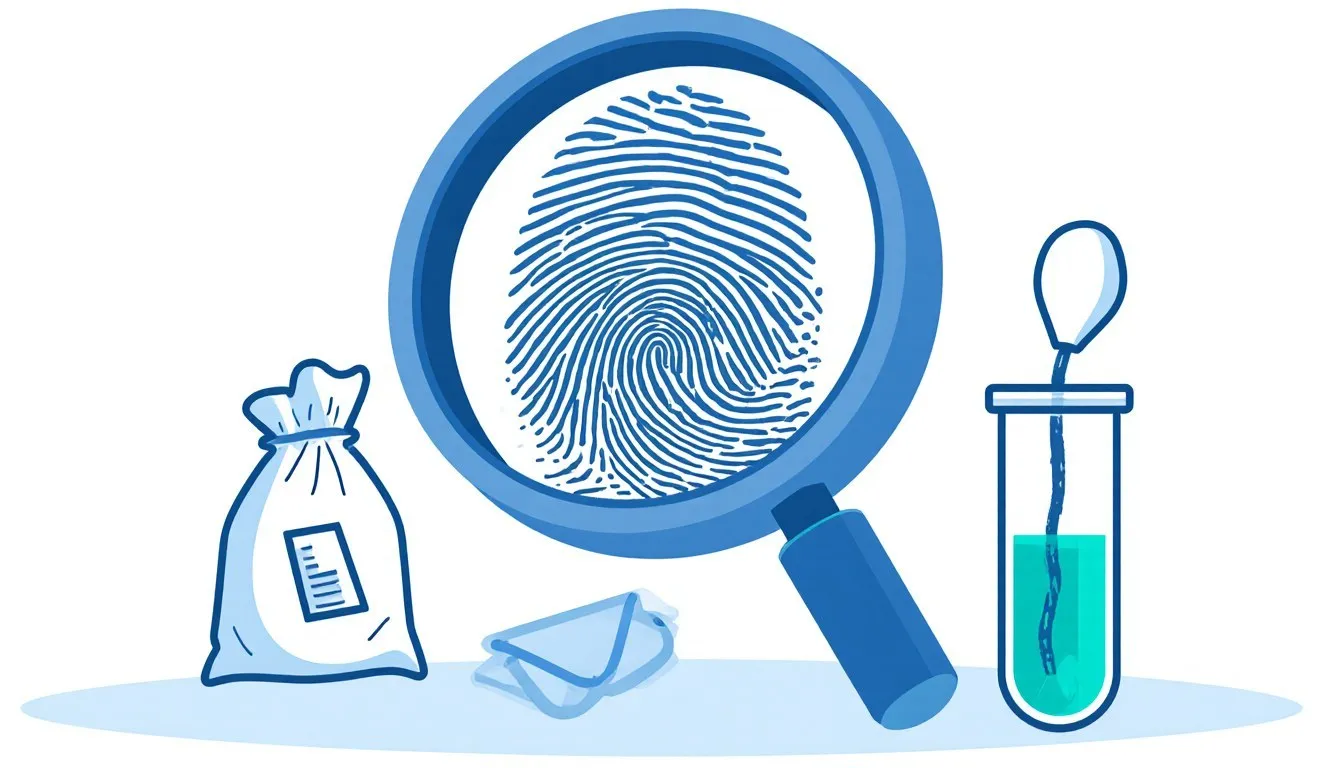
By its minutiae: the specific points where a ridge ends abruptly or splits in two, plus rarer features like short ridges, islands, and enclosures. An examiner compares the relative positions, orientations, and ridge-count spacing of those points between an unknown print and a known one, and an identification stands or falls on that comparison. Classification starts a level above, with three broad pattern types, loops, whorls, and arches, and loops alone account for the majority of all human fingerprints. That coarse level cannot identify anyone; it only sorts.
Those points come from fetal development, when the skin of the volar pads buckles under growth stresses in a process nobody can predict or repeat. The broad pattern is partly genetic, which is why relatives sometimes share a general type. Below that level, genetics runs out of influence entirely. Identical twins share a genome, and their fingerprints still differ. That is the cleanest demonstration available that the pattern comes from the physical accidents of one particular fetus in one particular womb. Those accidents never repeat, not even for two babies sharing a uterus and a genome.
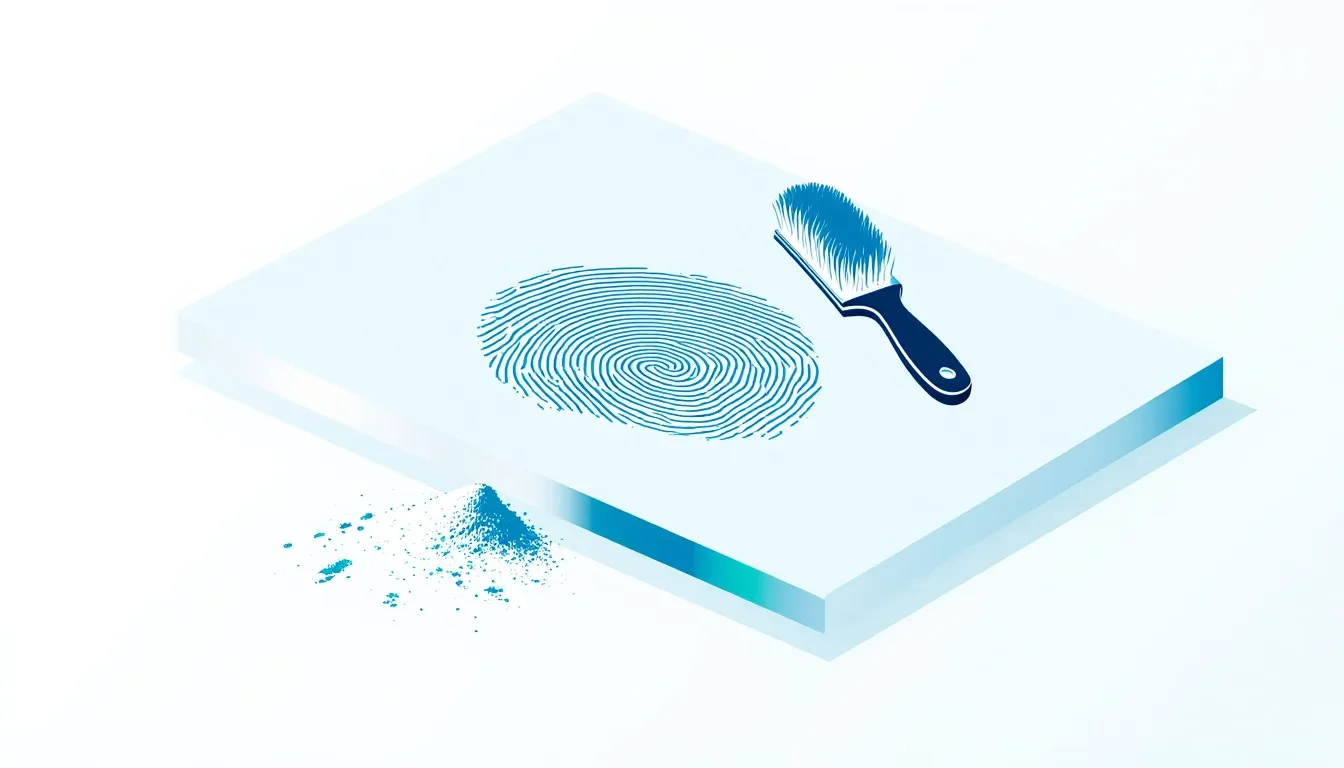
What made fingerprints stick as evidence for over a century is a combination of properties that is genuinely hard to beat. The pattern is fixed from before birth until decomposition. It is deposited involuntarily, in sweat and sebum, by anyone who touches anything ungloved. It can be recovered from a surface with powder, cyanoacrylate fuming, or chemical treatments like ninhydrin that react with amino acids in the residue. And it can be searched against enormous databases automatically.
The honest limitation is that latent prints from real scenes are usually partial and often smeared. Comparing a partial print to a full one takes expert judgment. The examiner has to decide which differences are real and which come from how hard the finger pressed, or from the shape of the thing it pressed against. A ridge pattern laid down on a curved surface stretches, and that stretch can look exactly like a genuine difference. There is also no universal minimum number of matching minutiae required. The standards that once existed varied by country, which tells you how much of this rests on trained judgment rather than a bright line. For the ridge anatomy in full, how fingerprinting works follows the residue from a fingertip through powder, fuming, and ninhydrin to a developed print, while identifying types of fingerprint patterns gives the loop, whorl, and arch classification more room than a survey like this one can spare.
What happens to evidence between the scene and the courtroom?
This is the part television skips entirely, and it is the part that decides most cases.
Every item collected gets a unique identifier and an unbroken written record of who had it, when, and why. That record is the chain of custody, and it exists to answer one question a defense attorney will certainly ask: can you prove this is the same item you collected, in the same condition? A gap in the chain leaves tampering impossible to rule out, and that alone is usually enough to blunt the evidence or keep it out of the trial. Nobody has to allege that anything was actually done to the sample. Cases have collapsed on a single missing signature at the bottom of a transfer form, with the underlying analysis never once in question.
Then the sample reaches a lab, and it waits. This is the reality that surprises people most. Public forensic laboratories run persistent backlogs, and the wait for a routine analysis is commonly measured in months. The worst backlogs sit in the two disciplines with the highest demand, DNA and digital devices. The queue comes down to arithmetic. Caseload has grown faster than the number of trained analysts for decades, and you cannot hire a qualified DNA analyst the way you hire seasonal help.
How DNA typing works
The dominant method examines short tandem repeats, or STRs: stretches of DNA where a short sequence is repeated back to back, and where the number of repeats varies a lot between people. At one location a person might carry twelve repeats on one chromosome and sixteen on the other. That pair of numbers is their type at that location. It is not unique, plenty of people share it. Combine twenty locations and the combined frequency becomes vanishingly rare in the general population.
The workflow is extraction of DNA from the sample, quantification of how much you got, amplification of the target regions by PCR, separation of the fragments by size, and comparison of the resulting profile against a reference sample or a database. The FBI’s Combined DNA Index System, CODIS, is the American infrastructure for that last step, holding profiles from convicted offenders, arrestees in some jurisdictions, and unsolved-case evidence, so that a profile developed today can hit against a scene from years ago.
DNA earns its reputation because the underlying statistics are calculable in a way that no pattern-matching discipline can match. An analyst can state a random match probability with a defensible number attached. That is a fundamentally different kind of claim from “these two marks are consistent.”
The complications are real, and they scale with sensitivity. Modern methods can amplify from a handful of cells, which means they can amplify from cells that arrived by innocent secondary transfer: you shook someone’s hand, they touched a doorknob, your DNA is now on a doorknob you never touched. Mixtures of three or more contributors get genuinely hard to interpret and are increasingly handed to probabilistic genotyping software rather than an examiner’s eye. Degraded samples yield partial profiles. And contamination is a permanent hazard when your instrument can see a few dozen cells, which is why analysts wear masks and lab coats. At that sensitivity the traffic that matters runs from the analyst into the sample: a shed skin cell, a stray breath over an open tube.
Finally the analyst writes a report, and eventually testifies. Testimony has its own discipline: stating what the result supports without overstating it, and saying “I cannot determine that from this evidence” clearly enough that a jury hears it. That sentence is the hardest one in the job.
Where does forensic science get it wrong?
The field’s weakest joints are well documented, mostly by the field itself, and pretending otherwise does no one any favors.
The deepest problem is that the disciplines differ enormously in how much validation sits underneath them. From the witness stand they all sound equally authoritative. DNA typing and drug chemistry rest on measurable, statistically characterized foundations. Several comparison disciplines rest largely on the trained judgment of examiners, without published error rates for the specific kind of comparison being offered. A landmark 2009 National Research Council report on forensic science in the United States said this plainly and prompted a long, still-unfinished reckoning. Bite-mark comparison on human skin has fared worst under scrutiny, because skin distorts, bruises change over time, and the claim that dentition is uniquely identifiable in a bruise was never established the way it was assumed. Several convictions built substantially on bite-mark testimony have been overturned by later DNA testing.
Then there is cognitive bias, a property of ordinary human perception that turns up in conscientious examiners as readily as careless ones. An examiner who has been told the suspect confessed is looking at an ambiguous comparison with an expectation already installed. The mechanism is ordinary perception doing its job. A genuinely ambiguous comparison has to be resolved somehow, and the expectation already sitting in the examiner’s head is the nearest tool available for resolving it. Hand the same examiner the same two prints on two occasions, with different case information attached each time, and the conclusion can come out differently. The countermeasure is procedural: keep analysts blind to case information they do not need, and have verifications done by someone who does not know the first examiner’s conclusion.
Contamination is the third. It happens at scenes, in transport, and in labs, and the more sensitive the method the more consequential a stray cell becomes. Serious labs maintain elimination databases of staff profiles precisely so they can recognize their own contamination when it appears.
And then there is the ordinary failure mode of overstatement. A result that genuinely means “this is consistent with, and cannot be excluded as” gets delivered in language that a jury hears as “this is a match.” The gap between those two statements is where a lot of wrongful convictions live. Weighing what the field gets right against what it costs is an argument in itself, and the advantages and disadvantages of forensic science lays out both columns.
Taken together, all of that describes a set of tools with sharply different precision. The practitioners worth trusting are the ones who tell you which tool they used and how sharp it actually is.
How did forensic science become a science in the first place?
Each advance in this history solved a specific, embarrassing failure of the method before it. That is the useful way to read it.
The founding problem was mundane: police could not reliably tell whether the person in front of them was a repeat offender. A man arrested under a new name in a new city was, for practical purposes, a new man. Names were useless and photographs were nearly as bad, because a filing cabinet of thousands of portraits cannot be searched by looking at faces.
Alphonse Bertillon, a clerk in the Paris police in the 1880s, attacked this with measurement. His system, anthropometry, recorded a set of bodily dimensions: head length and width, forearm, foot, middle finger, and others. Any one of those measurements is shared by a great many people. Take enough of them together and the pool of people who match on all of them collapses, which was the whole idea. Crucially, the measurements were numbers, so records could be filed in a searchable order. It was a genuine intellectual leap: identification as a classification problem rather than a memory problem. Bertillon’s system spread across Europe and America.
It also failed, in two ways. Measurements taken by different officers with different care did not agree, and the system could confuse people who were genuinely similar in build. Fingerprints solved both. They required no calipers and no judgment to record, and the pattern was individual rather than merely distinctive. Scotland Yard established a fingerprint bureau in 1901, and within a few decades fingerprinting had displaced anthropometry almost everywhere.
Locard’s Lyon laboratory, opened in 1910, addressed a different gap. Fingerprints identified people who touched things. Most scenes have no usable print, but they always have dust, fibers, soil, and residue. A dedicated laboratory meant that this microscopic material could be examined systematically rather than ignored, and it made the transfer principle operational rather than merely true.
Fingerprints still had a hard ceiling: they only work when the offender’s hands touched a suitable surface and the print survived. Blood, semen, and hair are left far more often, and until the 1980s they could only be typed into broad groups shared by millions. Alec Jeffreys, working at the University of Leicester in 1984, found that certain repetitive regions of DNA varied enough between individuals to produce a pattern he called a DNA fingerprint. Its first criminal use is instructive about what the technique actually is: it exonerated a young man who had already confessed to a murder in Leicestershire before it identified the man who committed it. A tool that clears the innocent is doing the same job as one that convicts the guilty, and the field’s own history keeps making that point whether or not anyone wants to hear it.
DNA methods then chased their own limitations, from techniques requiring a bloodstain the size of a coin down to PCR-based STR typing that works on a few cells, with searchable national databases arriving in the 1990s. Every step in the chain from Bertillon forward was somebody looking hard at where the previous method broke.
What does a forensic scientist’s actual day look like?
Three things about the job stand out: how narrowly the work is divided, how slowly it moves, and how carefully the results have to be worded.
The work is divided among people who rarely swap jobs. Crime scene investigators or evidence technicians document and collect at scenes; many are civilians, some are sworn officers, and their expertise is in recovery and documentation. Laboratory analysts stay in the lab and usually specialize narrowly enough that a DNA analyst does not run the drug chemistry and a firearms examiner does not touch either. Forensic pathologists are physicians with years of post-medical-school training who work in a medical examiner’s office. Nobody collects the evidence, runs the DNA, interrogates the suspect, and makes the arrest. That character does not exist, and if they did, the defense would have a field day with the contamination and bias implications of one person touching every stage.
The pace is slower by orders of magnitude. Instrument runs take hours. Cultures and extractions take longer. Reports get written, reviewed by a second qualified analyst, and revised. Court testimony arrives months or years after the analysis, which is why contemporaneous notes are so obsessively kept: you will be asked, under oath, to explain a decision you made two years ago, and your memory will be no help at all. The paperwork is the job to a degree that surprises every new hire.
And the results come out as probabilities. A screen that comes back presumptive positive for blood means the sample reacted the way blood reacts and also the way several other substances react, so it needs confirming. A profile “cannot be excluded” as coming from a suspect. A time of death is reported as a window, and that window widens with every hour that passes. Temperature, body mass, and clothing each stretch it further. Jurors now arrive expecting a clean answer in every case, and often expecting DNA specifically, including in the many cases that never had biological evidence to find. A good deal of court time goes to explaining why a burglary produced no profile at all.
The instruments do less of the deciding than they appear to. A mass spectrometer produces a spectrum, and a human decides whether that spectrum matches a reference well enough to report it. A database search returns candidates, and a human confirms or rejects them. The machine narrows the field to a short list of candidates. The conclusion is the analyst’s, and their name goes on it.
What does forensic science ask of the people who do it?
Forensic science is unusual among the sciences in that being wrong has a named victim. A chemist who misassigns a peak in a research paper causes a correction. A forensic chemist who misassigns a peak can put someone in prison. That asymmetry is why the good practitioners are so relentlessly conservative in their language, so committed to documentation that looks like bureaucracy from outside, and so willing to say the words that make for terrible television: the evidence does not tell us.
The satisfying part, for anyone who likes science for its own sake, is that all of it reduces to ordinary principles you can meet in a school lab. Chromatography separating a mixture. Antibodies binding a specific protein. The geometry of a projectile’s path. Insects developing at rates that track ambient temperature. Any one of those will run on a school bench. What makes forensic work hard is the setting around it: one sample, no second run, and an adversary in the room paid to find the crack in your reasoning.
So try the transfer principle on your own hands. Look at what you have touched in the last ten minutes and think about what moved in each direction, what would still be detectable in an hour, and what the weather would do to it. Run that over the doorknob you just turned, the cup you set down, the sleeve that brushed a wall on your way past. Ask what a careful search would recover an hour from now, and what it would recover tomorrow, and whether finding nothing would tell you the touch never happened. You are doing the reasoning the whole field is built on, at small scale and with nothing at stake.
Nora Whitfield
Staff Writer
Nora Whitfield taught high-school chemistry and physics for twenty-eight years, and she has never once answered "when will I use this?" with a sigh. She believes any honest question about how the world works deserves an answer that is both correct and actually understandable.