
Every Rock You Pick Up Is Halfway Through Becoming Something Else
Igneous, sedimentary and metamorphic rocks are named for three processes: cooling, settling, and squeezing. Read any rock’s texture as the record of which one.
The three names are three verbs. Igneous rock cooled from a melt. Sedimentary rock accumulated as loose pieces or dissolved chemistry and later got glued together. Metamorphic rock was heated and squeezed into a new mineral arrangement without ever going liquid. Those three verbs make up the whole classification, and none of it has anything to do with color, hardness, weight, or whether the rock is handsome.
Which leads to the part that makes the subject worth more than a memorization quiz. A rock is not a finished object. The quartz grains in a beach sandstone were once locked in granite; that granite crystallized from magma that was, at some earlier point, melted seafloor basalt; and if you bury that sandstone deep enough it will become quartzite, and deeper still it will melt and start over. Every specimen you can hold is one frame pulled out of a very slow film. Below, what each of the three processes actually does to rock, how to read the result in a hand sample, and how to spot the whole business happening in a road cut on your way to work.
What actually separates igneous, sedimentary, and metamorphic rock?
They are sorted by origin, and only by origin. Igneous means it solidified from molten material. Sedimentary means it was assembled at or near the surface out of the debris and dissolved remains of older rock. Metamorphic means an existing rock (the protolith) was reorganized in the solid state by heat, pressure, or chemically active fluids.
The misconception worth naming first is the one every drawer of unlabeled samples produces: that the categories are about appearance. Dark and heavy must be igneous. Layered must be sedimentary. Sparkly must be metamorphic. Every one of those rules of thumb fails on its second sample. Obsidian is jet black, glassy, and igneous; slate is dark, splits in sheets, and is metamorphic; coal is black, light, and sedimentary. Meanwhile, plenty of igneous rock is layered, because ash falls in beds just like mud does, and plenty of metamorphic rock is dull gray with nothing sparkly about it.
What the categories really give you is a question you can answer from the rock itself: what was this material doing when it became solid rock? Three answers, three families.
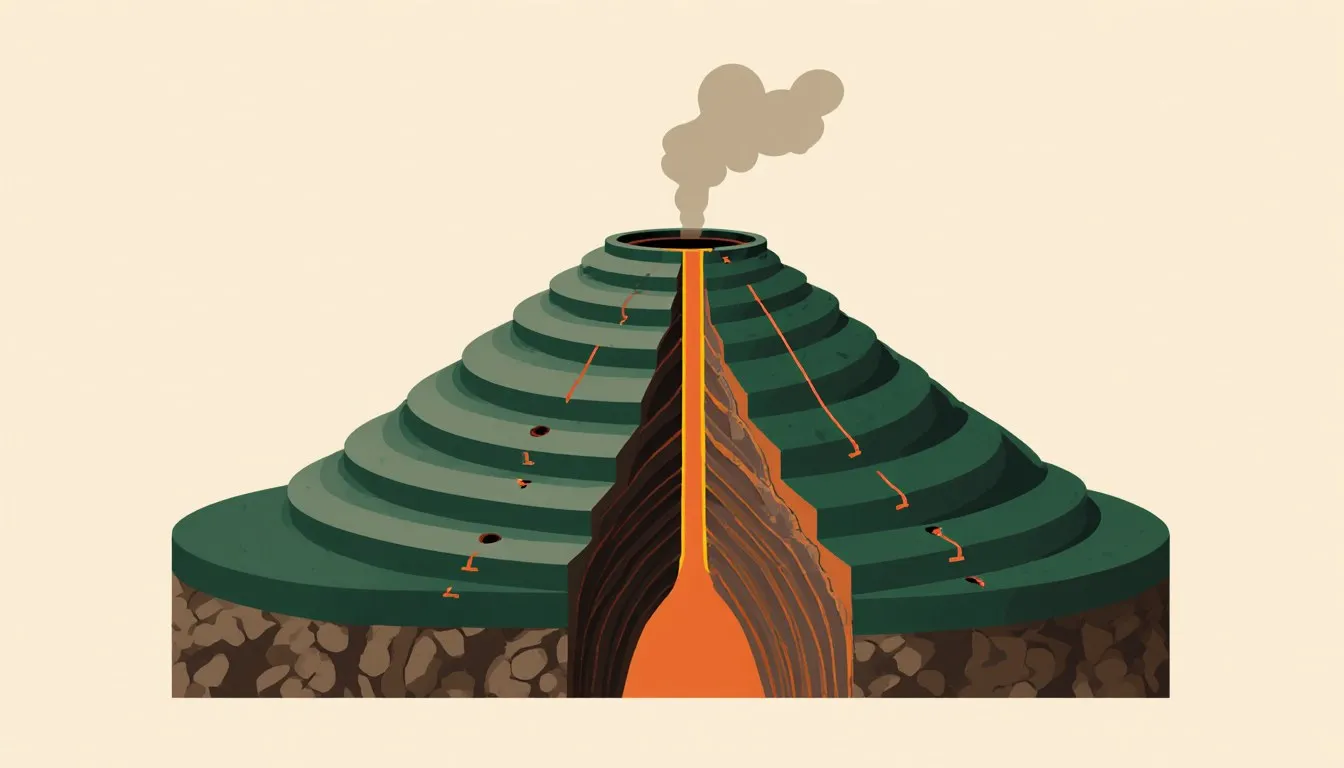
- Cooling: atoms in a melt lose energy, lock into crystal lattices, and interlock with their neighbors like pieces in a jigsaw. There are no gaps between the crystals because they grew into each other.
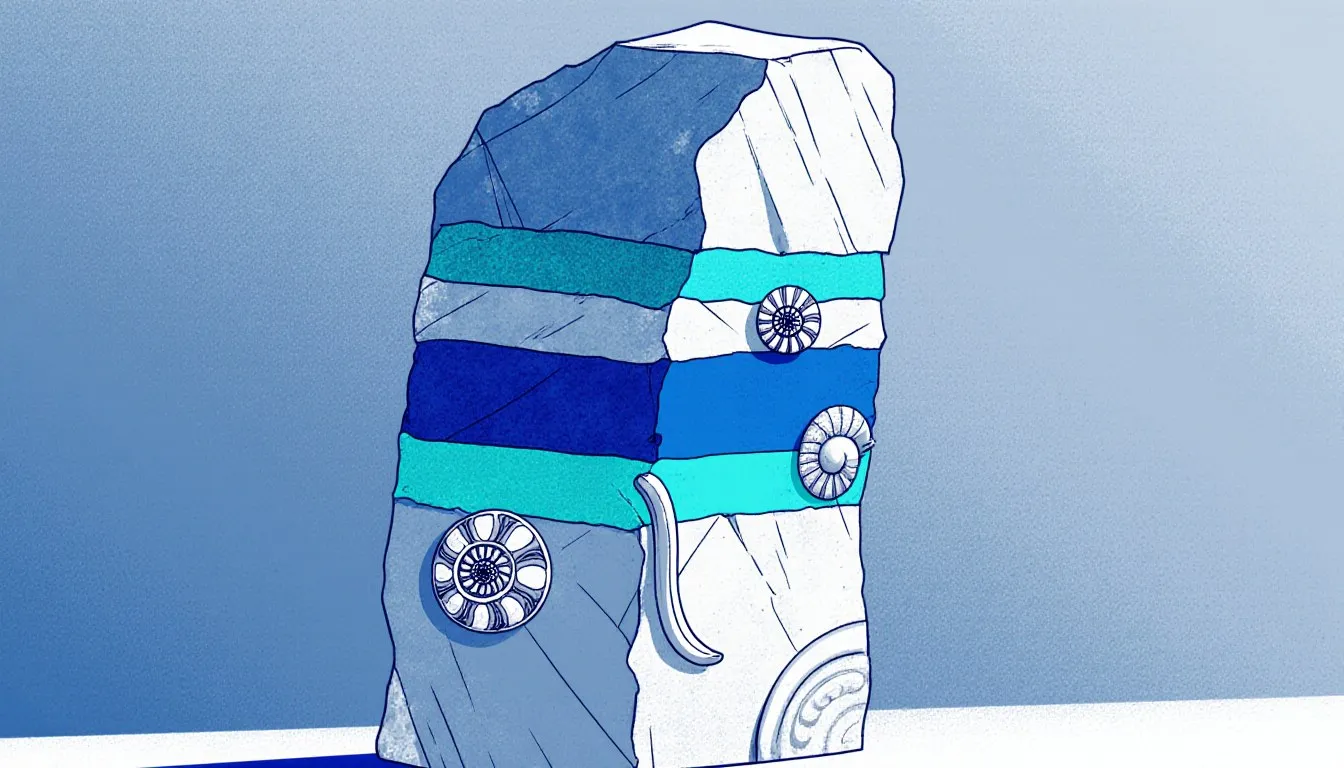
- Accumulating: pieces of older rock, shells, or dissolved ions settle out of moving water, wind, or ice, pile up in layers, and get compacted and cemented. The grains were separate first and are stuck together second.
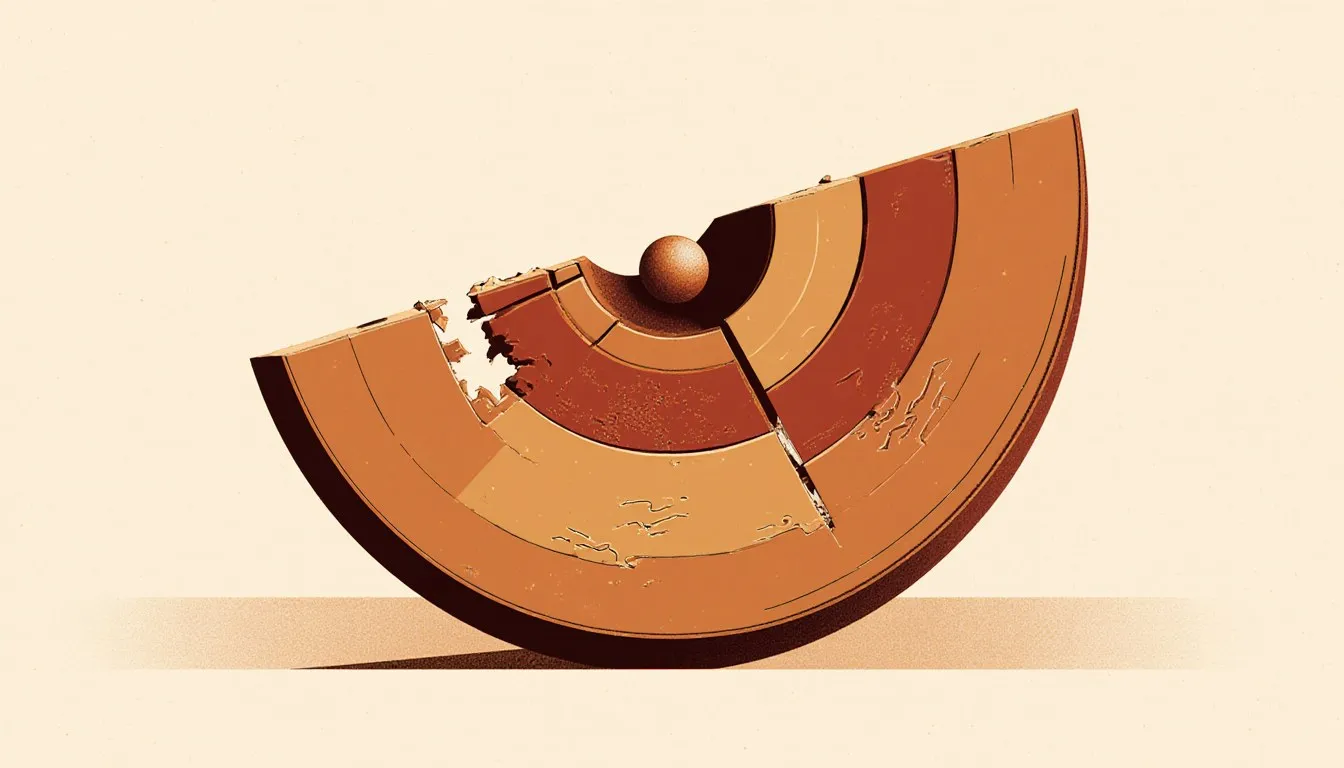
- Reshaping: a solid rock is held at temperature and pressure long enough that its minerals recrystallize, grow, flatten, or line up. Nothing pours; the atoms migrate through solid material, one lattice site at a time.
The proportions surprise people. By volume, the crust is overwhelmingly igneous and metamorphic; sedimentary rock is usually put at only about five percent of crustal volume. Yet sedimentary rock covers roughly three quarters of the land surface, which is why the rocks in your yard are probably sandstone, shale, or limestone even though the bulk of the ground below is not. You live on the frosting.
How does the rock cycle turn one type into another?
Three transformations connect the families, and each one is defined by which threshold the rock crosses. Cross the melting point and you are headed for igneous rock. Get broken down at the surface and carried away, and you are headed for sedimentary rock. Get buried and cooked but stop short of melting, and you get metamorphic rock. Uplift and erosion move material back up to the surface to start again.
Every rock family can feed every other one, which is the part that people draw wrong. Granite can weather into sand that becomes sandstone. Sandstone can be metamorphosed into quartzite. Quartzite can melt into magma. Magma can freeze into granite. But sandstone can also go straight back to sand without ever being metamorphosed, and gneiss can be exposed by erosion and weather into mud, skipping the melt entirely. There is no required order and no lap you must complete.
I used to draw the loop on the board with arrows going around the outside and then, deliberately, add the shortcuts straight across the middle, because the neat circular version teaches a wrong idea: that rock moves through the stages in sequence like a student moving through grades. It doesn’t. It goes wherever the conditions send it, and it can be sent backward. Laying the arrows out properly, with each pathway’s conditions attached, is a job for a proper rock cycle diagram rather than for a paragraph.
Timescale is the other thing that gets flattened. The transformations are not equally slow. A basalt flow can go from liquid to solid rock in days. Lithifying a mud into shale can take millions of years of burial. Regional metamorphism runs on the schedule of mountain building, tens of millions of years of two continents leaning on each other. So a “cycle” made of steps that differ by nine orders of magnitude in duration is really a set of independent processes that happen to hand material back and forth.
One consequence is worth holding onto: the atoms are old even when the rock is young. Grains of zircon recovered from the Jack Hills of Western Australia date to roughly 4.4 billion years, and they were found sitting inside a much younger sedimentary rock, having survived at least one full trip through erosion, transport, and burial. Zircon is the reason those grains lasted: the crystal is hard, chemically stubborn, and survives the transport that grinds its neighbors to clay, and its lattice takes up uranium while refusing lead, so the clock inside it starts at crystallization and keeps running through every later burial. A geologist logging that outcrop would write down a rock age billions of years younger than the grains sitting in it.
How do igneous rocks form, and why does cooling speed matter?
Crystal size records cooling rate, and that single relationship does most of the work in igneous rock identification. Slow cooling gives atoms time to find their way to a growing crystal face, so crystals get big. Fast cooling freezes the melt before crystals can organize, so grains are tiny or absent altogether.
That divides the family in two by where the cooling happened. Intrusive (or plutonic) rock cools underground, insulated by kilometers of overlying rock, sometimes taking hundreds of thousands of years to finish. Granite and gabbro are intrusive, and you can see every individual crystal without help. Extrusive (or volcanic) rock cools at the surface, in air or water, in hours to years. Basalt and rhyolite are extrusive, and their crystals are generally too small to resolve with the naked eye. Obsidian is the extreme case: chilled so fast that no crystal lattice formed at all, which is why it is a glass and why it fractures in those smooth curved shells that made it the best blade material available for most of human history.
The everyday version of this is a sugar syrup. Cool it slowly on a string and you grow big rock-candy crystals; pour it onto a cold slab and stir it fast and you get fudge, where the crystals are too small for your tongue to feel; drop the temperature fast enough and you get hard candy, a glass with no crystals in it. That analogy earns its keep and then stops. Sugar has one ingredient; magma is a chemical soup where different minerals crystallize at different temperatures, so the melt’s composition changes as it freezes and the last minerals to form are working with leftovers. The candy on the stove does not do that.
Cooling in two stages leaves a signature you can read directly. A rock with large, well-formed crystals floating in a fine-grained background (a porphyritic texture) spent a long time cooling at depth, growing those big crystals, then got erupted and finished the job fast. The rock is telling you it changed addresses partway through. Textures like that one are most of what the characteristics of igneous rocks come down to: grain size, grain shape, gas holes, and glass, each of them a record of how fast the heat left.
Composition is the second axis, and it runs roughly from light to dark. Silica-rich rocks with abundant quartz and potassium feldspar are pale and comparatively low density; iron- and magnesium-rich rocks with pyroxene and calcium-rich feldspar are dark and denser. Granite and basalt are the standard endpoints of that range, and the pairing of texture with composition is exactly why granite (coarse, pale) and rhyolite (fine, pale) can share a chemistry while looking nothing alike, as can basalt and gabbro at the dark end. Everything else sits between those two endpoints, and the mafic vs felsic split is how petrologists sort the middle: how much silica the melt carried against how much iron and magnesium, which sets the density, the color, and the temperature the magma erupted at. To hold the coarse dark end in your hand, pick up gabbro rocks, because the crystals are big enough that you can identify the pyroxene by eye instead of taking somebody’s word for it.
One more thing the melt records: depth. Basalt makes up most of the ocean floor because that is where mantle material rises, decompresses, and melts. Granite is a continental rock because it takes a thick crust to produce and store that much silica-rich magma. The distribution of igneous rock types is a map of what the planet was doing underneath them.
How do sedimentary rocks record what was happening at the surface?
Because they are made of the surface, layer by layer, in the order it happened. A sedimentary rock is a stack of past days: the grain size tells you how fast the water was moving, the grain shape tells you how far the pieces traveled, the chemistry tells you what was dissolved in the water, and the fossils tell you what was alive and, often, whether it lived in fresh water, salt water, or on land.
The route from rock to rock has a fixed sequence. Weathering breaks the parent rock down mechanically (frost wedging, abrasion, root pressure) and chemically (feldspar reacting with slightly acidic water to become clay). Erosion picks the pieces up. Transport moves them and rounds them, dropping the heaviest first. Deposition parks them where the current can no longer carry them. Then burial compacts the pile, squeezing water out and packing grains together, and cementation precipitates minerals in the remaining pore space, usually calcite, silica, or iron oxides, which is what actually welds the grains into rock. Compaction and cementation together are lithification.
The family splits three ways by what got deposited.
- Clastic: physical fragments of older rock, sorted by size. Shale from clay, siltstone from silt, sandstone from sand, and conglomerate from rounded gravel (its angular cousin is breccia, and the difference between rounded and angular is a travel record: rounded clasts were tumbled a long way, angular ones were not). What a coarse clastic rock can tell you about ancient currents is the whole subject of conglomerate rock.
- Chemical: minerals precipitated directly out of solution. Rock salt and gypsum from evaporating water bodies, some limestones, and much chert, a dense microcrystalline quartz rock that our ancestors knapped for tools long before they knew what quartz was. Chert’s origins, part chemical and part biological, are messier and more interesting than that one-line version; there is more in information about chert rock.
- Organic (biochemical): accumulated remains of living things. Coal from compressed plant material in ancient swamps, and most limestone from shell, coral, and skeletal debris built out of calcium carbonate that organisms pulled from seawater.
Which corrects an error that shows up constantly on classroom charts and in rock-kit labeling: limestone is not a clastic rock. Its calcium carbonate came out of solution or out of organisms, not from the mechanical breakdown of older rock. Sandstone is clastic. Limestone is not, and putting them in the same bin loses the entire distinction between “pieces of rock piled up” and “chemistry that turned into rock.” Limestone earns its own attention anyway, since it is the raw material for cement, agricultural lime, and a long list of industrial processes; uses of limestone covers that side of it.
Fossils belong almost exclusively to this family, and the reason is mechanical. Melting destroys organic structures completely, and metamorphism deforms and recrystallizes them, though low-grade metamorphic rocks like slate do sometimes preserve smeared, stretched fossils that survived the squeeze. Sedimentary burial is the only process gentle enough to keep a shell shaped like a shell. That accident of chemistry is why the entire history of life is written in about five percent of the crust. Sedimentary rock formation is worth following one step at a time, since the burial chemistry is where most of the confusion sits: compaction and cementation do different jobs, and only one of them is what makes the rock hard. The characteristics of sedimentary rocks are the other half of that, the short list of features that lets you call a bed from the shoulder of a road without touching it.
What turns rock into something new without ever melting it?
Heat and pressure applied to a solid, held long enough for the atoms to rearrange. Metamorphism is conventionally taken to begin somewhere around 200 °C (about 390 °F), below which we call the changes diagenesis, and it ends wherever the rock starts to melt, which for wet granitic material can be as low as roughly 650 °C (about 1200 °F). Between those two lines, the rock stays solid while its minerals are entirely rebuilt.
Solid-state change is the idea students resist hardest, and fairly, because it sounds like cheating. The useful comparison is a metal blacksmiths and machinists already know: heat a piece of steel below its melting point, hold it there, and the grain structure inside changes, atoms migrating across boundaries, new grains growing at the expense of old ones. The bar never becomes liquid and it is not the same metal afterward. Rock does the same thing on a longer clock, with the added complication that hot fluids move ions through the rock and let entirely new minerals grow, which the steel bar does not do.
Two settings account for most of it. Contact metamorphism happens where magma intrudes cooler rock and bakes a rind around itself, usually a zone from centimeters to a few kilometers wide depending on the size of the intrusion. It is heat-dominated, with little directed pressure, so the resulting rock (hornfels is the classic) tends to be hard, fine, and randomly oriented. Regional metamorphism happens across whole belts of crust during mountain building, where rock is buried deep and squeezed unequally from one direction. That directed stress is what produces the texture that makes metamorphic rocks recognizable.
Foliation is the alignment of platy or elongate minerals perpendicular to the direction of squeezing. Picture a box of loose playing cards shaken flat: the cards end up lying parallel because that is the low-profile orientation. Mica flakes and clay minerals do the same under pressure, and once they line up the rock splits along that plane. The point where the analogy breaks is that the cards merely rotate, while in rock the flat minerals also grow in that orientation, new crystals forming already aligned.
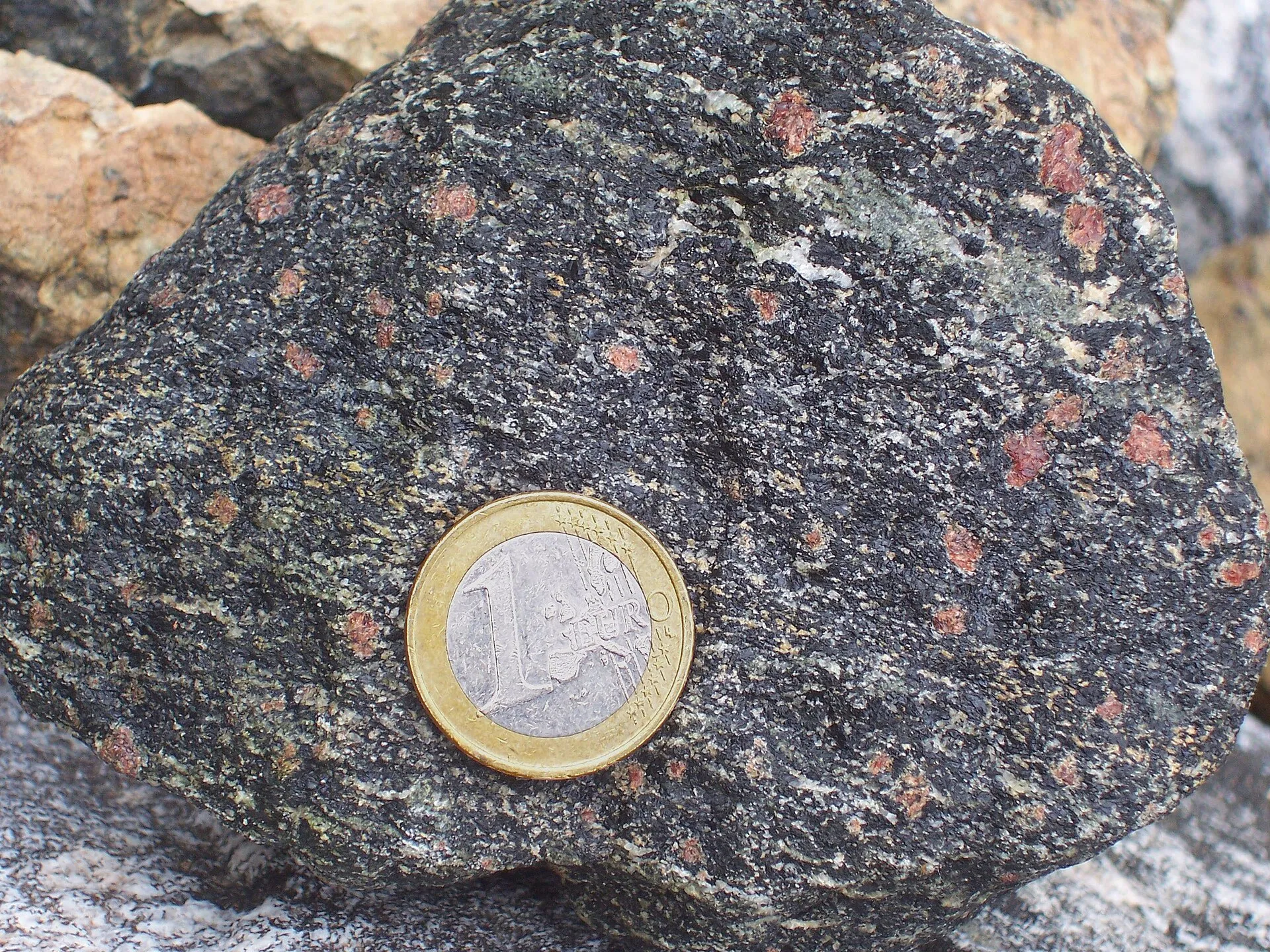
Turn up the intensity on a shale and you get the whole foliated series in order: shale becomes slate (fine, splits into sheets), then phyllite (a silky sheen as the micas coarsen), then schist (visible flakes, obvious sparkle), then gneiss (minerals sorted into pale and dark bands). Slate carries a detail worth pointing at. Its splitting planes form perpendicular to the squeeze, which often has nothing to do with the original sedimentary bedding, so a good roofing slate frequently splits at an angle across the very layers it was deposited in. The rock has two fabrics in it, from two different eras, and you can see both.
Non-foliated metamorphic rocks form where the protolith has no platy minerals to align, or where heat dominated and directed stress did not. Limestone recrystallizes into marble, its calcite grains growing and interlocking and, in the process, erasing every fossil it contained. Sandstone recrystallizes into quartzite, with silica filling the pore space so completely that the rock breaks straight through the sand grains rather than around them. Both are the same chemistry as their parents; the arrangement is what changed. The full identification set, including the index minerals that pin down how hot a rock got, is laid out in metamorphic rock characteristics. And the popular story about coal being squeezed into diamonds is more complicated than the version everyone repeats, which is why how does coal become diamond exists as its own question.
How can you tell the three types apart just by looking?
Start with how the pieces meet each other, because that one observation sorts most hand samples before you know a single mineral name.
- Interlocking crystals, no layering, no preferred direction: igneous. The crystals grew into each other from a melt, so their boundaries are irregular and jigsawed with no gaps. If it also has holes from gas bubbles, or is glassy and shell-fractured, it is volcanic.
- Separate grains you can see the outlines of, often with visible layers: sedimentary. The grains were rounded before they arrived, so they meet at contacts with cement between them rather than growing into each other. A gritty feel and grains that rub off on your thumb are strong evidence.
- Interlocking crystals that are also aligned, banded, or split in sheets: metamorphic. Foliation is the one texture the other two families cannot produce. Bands of light and dark minerals, a sparkle that all catches the light at the same angle, or a rock that splits into flat plates all point here.
- Interlocking crystals, no alignment, but no melt textures either: possibly non-foliated metamorphic. Marble and quartzite land in this awkward middle, which is where the scratch and acid tests earn their keep.
Four tests you can genuinely do at a kitchen table:
- The scratch test. A steel knife blade or a piece of window glass sits at about 5.5 on the Mohs scale. Calcite is 3, quartz is 7. So a knife scratches marble and limestone easily and will not touch quartzite or chert. That single check separates marble from quartzite most of the time. (Skip the old copper-penny trick unless you know you have a pre-1982 US cent; newer ones are zinc with a thin copper skin and give the wrong hardness.)
- The acid test. A drop of vinegar on limestone or marble produces a slow weak fizz as the acid attacks the calcium carbonate. Geology labs use dilute hydrochloric acid instead, which fizzes vigorously and unmistakably, and it stays a supervised classroom material: goggles, good ventilation, and if anyone is diluting stock acid, acid into water, never the reverse, so the heat of mixing has somewhere to go. For home use, vinegar answers the question and cannot hurt you.
- The break test. Hit a sandstone and it fails around the grains, leaving a sandy surface. Hit a quartzite and it fails through them, leaving a smooth glassy fracture that cuts straight across where the grain boundaries used to be. If you are breaking rock, wear safety glasses without exception; struck rock throws sharp chips at eye height, and quartz-rich rock in particular fractures into edges as keen as a scalpel.
- The wet test. Water in a spray bottle brings out banding, grain contacts, and cement color that a dry dusty surface hides. This costs nothing, and no other trick on this list works harder for you.
Nobody ever learned a texture from a photograph. Students match the photograph in the book to the wrong rock in their hand constantly, because a picture drops the two things that would have settled it: how the surface feels and how the grains meet. The fix is a shoebox of known samples you can pick up and compare. Get a labeled granite, a labeled sandstone, and a labeled gneiss, keep them in a drawer, and hold the unknown next to them. Your fingertips will sort the grains faster than your eyes will.
Why do geologists sort rocks this way in the first place?
Because sorting by origin lets you reconstruct history, and sorting by appearance does not. Earlier naturalists grouped rocks by hardness, color, and use, which was fine for choosing a building stone and useless for figuring out what the ground had been through.
The change came with the argument that the processes we can watch today are the same ones that built the rock record, given enough time. James Hutton’s fieldwork in Scotland in the late eighteenth century made the case physically: at Siccar Point he found near-vertical layers of old sedimentary rock, planed flat by erosion, with younger horizontal layers laid across the top. Reading that outcrop required a sequence of deposition, tilting, uplift, erosion, submergence, and deposition again, each step running at the pace we observe today, and the total came out to a span of time that dwarfed anything then contemplated. Hutton’s own summary of the view has stuck for two centuries: no vestige of a beginning, no prospect of an end.
Once you accept that framing, a classification based on formation process is the only one that pays. Naming a rock granite commits you to claims you can test: that it cooled slowly at depth, from silica-rich magma, in continental crust. Every one of those claims is checkable against the sample: the crystal size says the cooling was slow, the quartz and potassium feldspar say the melt was silica-rich, and the regional setting says the rest. Get the name wrong and one of the three checks catches you.
Modern conventions refine the same idea rather than replacing it. Igneous rocks are classified internationally by their mineral proportions using the scheme maintained by the International Union of Geological Sciences, which is why a petrologist in Chile and one in Norway mean the same thing by “granodiorite.” Sedimentary rocks are named by grain size and composition. Metamorphic rocks are named by texture and by the index minerals that record the peak temperature and pressure they reached. In all three, the name is a compressed hypothesis about the rock’s past.
The old sharp lines have gotten softer with better instruments, and that is a feature. There are volcanic rocks made of welded ash that behave sedimentologically. There are sediments whose alteration during burial grades imperceptibly into metamorphism. There are migmatites, rocks caught partway through melting, with a metamorphic half and an igneous half in the same hand sample. Categories with fuzzy boundaries are what you should expect from processes that run continuously.
Where can you actually see the rock cycle in action?
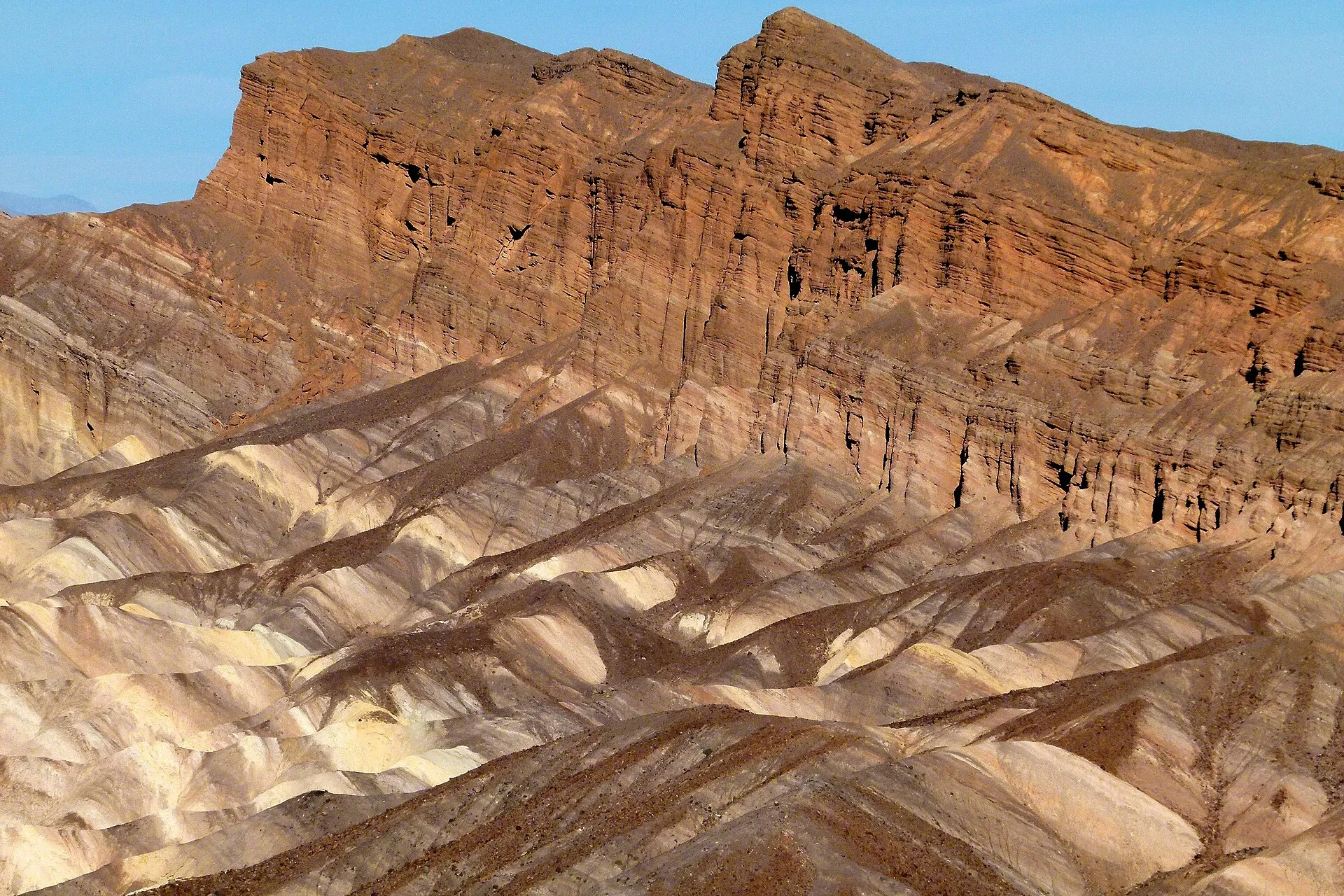
A highway road cut is the best free classroom in most of the country. The blasting exposes a clean vertical face, and you can often read a whole depositional history in it: layers changing thickness, an old channel cut into the beds below, a coarse conglomerate marking a flood. Look from the shoulder or a pullout well clear of traffic, or better, from the far side of the road, and check whether the land is public before you go closer, because most cuts sit on state right-of-way with rules about it.
A riverbed shows you the sorting machine working. Walk downstream and watch the clast size drop and the roundness climb, which is the mechanical half of sedimentary rock formation happening in real time at your ankles. Pick up a cobble at the head of a gravel bar and another a kilometer down, and the difference in the two is the entire concept of transport, demonstrated by the river for free.
An active quarry with a public viewing area, a beach where a headland is losing to the surf, a frost-shattered talus slope below a cliff, a stone building whose limestone facade is dissolving at the drip line under a downspout: all of these are the cycle at a speed you can catch. The steps we normally have to imagine, weathering and transport and deposition, are the fast ones. It is only burial, metamorphism, and melting that outlast us.
The transport half compresses into something that fits on a workbench: a barrel of grit and a motor does mechanically in a few weeks roughly what a river does to a pebble over a few hundred kilometers, which is the whole idea behind building a rock tumbler at home. Load it with the road-cut samples you were about to leave in the car, and the ones that come out shining will tell you something about their hardness that you did not know when you picked them up.
Nora Whitfield
Staff Writer
Nora Whitfield taught high-school chemistry and physics for twenty-eight years, and she has never once answered "when will I use this?" with a sigh. She believes any honest question about how the world works deserves an answer that is both correct and actually understandable.