


An Introduction: What is a Plasma Ball and How Does it Work?
Plasma balls are a fun accessory to have in your room. Not only do they add an eerie beauty to the atmosphere, you can also use them to perform some pretty neat tricks. However, have you ever wondered how these amazing devices work, and why they emit such strange colors of light. Let us find out.
Did You Know?
The first plasma lamp was invented and patented by Nikola Tesla in 1894. It was named ‘Inert Gas Discharge Tube’. However, commercial production of this product did not begin until James Falk marketed the modern version of a plasma ball in the 1970s.
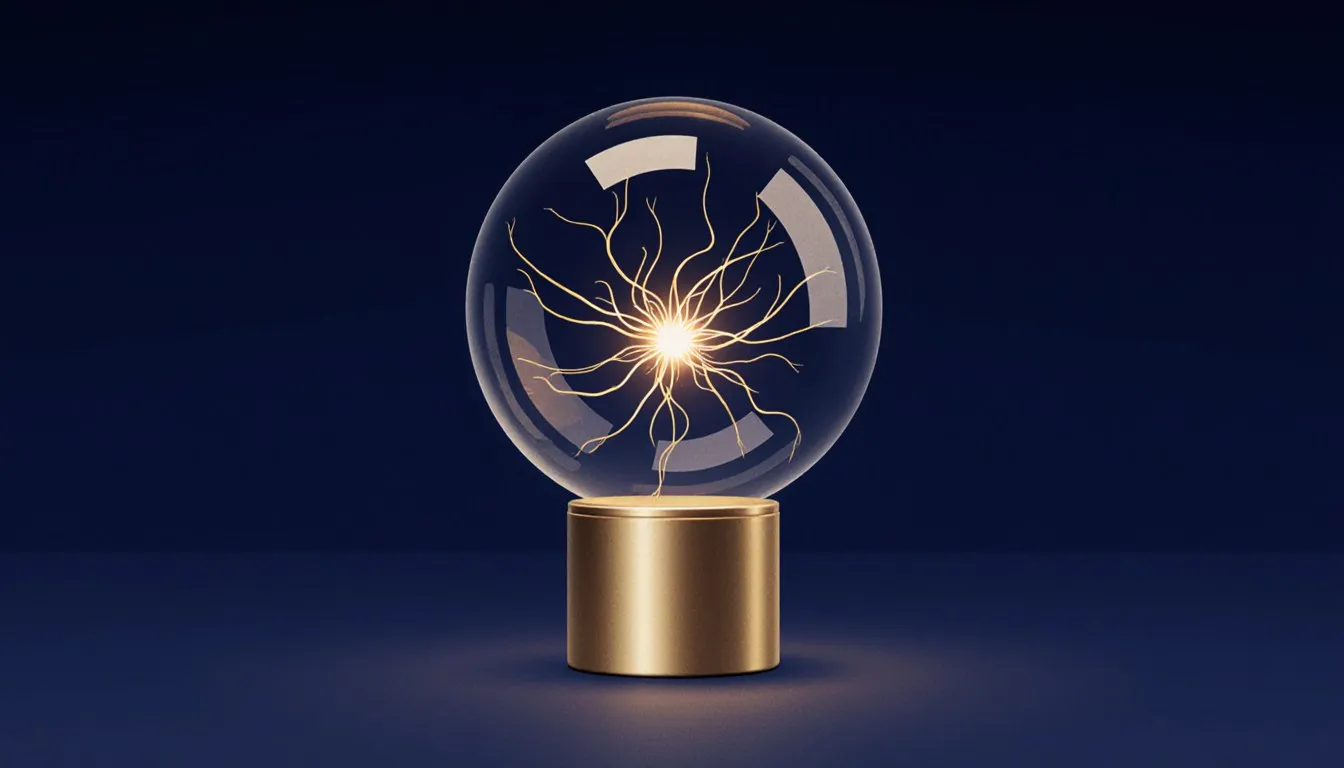
A plasma ball, also known as plasma globe/sphere/dome/tube/orb, etc., is a decorative ball of glass filled with noble gases in a partial vacuum that has an high-powered electrode in its center. The electrode emits tentacles of bright light which extend up to the glass sphere surrounding it.
Plasma lamps are primarily used as toys or decorative items that is truly eerie to look at. One may also perform a wide variety of lighting effects and tricks, by moving their hands around the sphere. Sometimes, school labs use these plasma balls to demonstrate science experiments. Despite not being used for general lighting purposes, some manufactures have turned these devices into night lamps, that are compatible with an ordinary electric socket. Let us look at the processes that take place inside a plasma ball to make the tentacles of beautifully colored light dance within the sphere.
Plasma balls are a sort of miniature Tesla coil. When you turn the device on, a high alternating voltage is passed through the electrode, which makes the electrons in the coil of wires in the electrode oscillate at a very high rate (around 30 kHz), eventually making the electrons from the gases to fall off. This leaves positive ions, which give the gases beautiful colors. Due to the partial vacuum inside the ball, the electric tentacles can be seen easily. Normally, the electric current is invisible. However, the ions of the noble gases react to the outflowing electrons, causing them to glow in various colors depending on the type of gas, by emitting large numbers of photons.
Modern plasma balls are manufactured with a mix of various noble gases such as xenon, neon, and krypton. With various shapes in the glass globes, computerized circuits, and the gas combinations, the plasma balls can create electric tentacles that create various shapes and patterns in different colors. You can also find USB plasma balls which are powered from the USB port of for computer. They are a safer version, due to the low current from the PC. However, the voltage is still very high, and can cause harmful EMF radiation.
- The plasma sphere can emit certain frequencies, which interfere with Wi-Fi signals and cell phones. So they must be kept away from such areas.
- These spheres also radiate electromagnetic waves. This can affect electric devices, hence they should be kept away from people with pacemakers.
- While using metal objects to create electric and fire tricks with the plasma globe, precautions such as protective clothing and insulation should be used.
- Never bring any flammable item near the globe.
- Magnets are usually good conductors of electricity. Hence, bringing plasma balls and magnets together create a potential for shocks and burns.
- Operating plasma balls for long periods of time can cause the formation of ozone gas, which is harmful to the body when you breathe it in.
In case you are wondering what to do with a plasma ball, we have provided a list of tricks that you can try out and amaze your family and friends. It is important to note that to ensure your safety from electric shocks and fires while performing the following tricks, adequate precautions have been taken.
- Light up Fluorescent Light bulbs: Argon bulbs, LEDs, and fluorescent bulbs will light up automatically, when they are brought close to a plasma ball. This is because the electric current will flow through the glass sphere to the light bulb.
- Writing With a Metal Pin: Cover the plasma ball with a sheet of foil. Now, place a piece of paper on the foil, and write anything you want onto it with a metal pin. Your writing will get burned onto the paper due to the current passing from the plasma ball to the pin. Be sure to take fire precautions.
- Lighting a Plasma Ball Without Keeping it Turned On: Turn on the plasma ball, and place your hand on top of it. Now, turn the plasma ball off, and immediately take your hand off and back onto the sphere. You will see the electric tentacles flash towards your hand. Take your hand off and clap repeatedly near the ball. This should induce a few more flashes of electricity.
- Messing with a Calculator: Take an inexpensive model of a calculator, and bring it gradually towards the plasma ball. The numbers on the screen will change automatically. However, do not use an expensive calculator, as this trick might damage the screen permanently.
- Lighting a Match: Hold an unlit match close to the plasma ball. Now, touch the tip of a pencil to the end of the match, and keep them near the ball for a minute. The match should light up. Blow the match off as soon as it lights up to prevent any risk of fire.
- Electric Shocks: Before you perform this trick, be sure to inform your friend about it. While placing one hand on the plasma ball, lightly touch your friend with the other hand. This turns you into an electric conductor, and your friend will receive a mild electric shock.
Apart from the fun tricks give above, plasma spheres can be used in a lot of experiments. So, if you are interested in the physics of electricity and light, the plasma ball is a good place to get started. Best of luck!