An In-depth Comparison of Cohesion Vs. Adhesion
Cohesion and adhesion are properties that account for the attraction between molecules. Liquids like water are known to exhibit both the properties.
Did You Know?
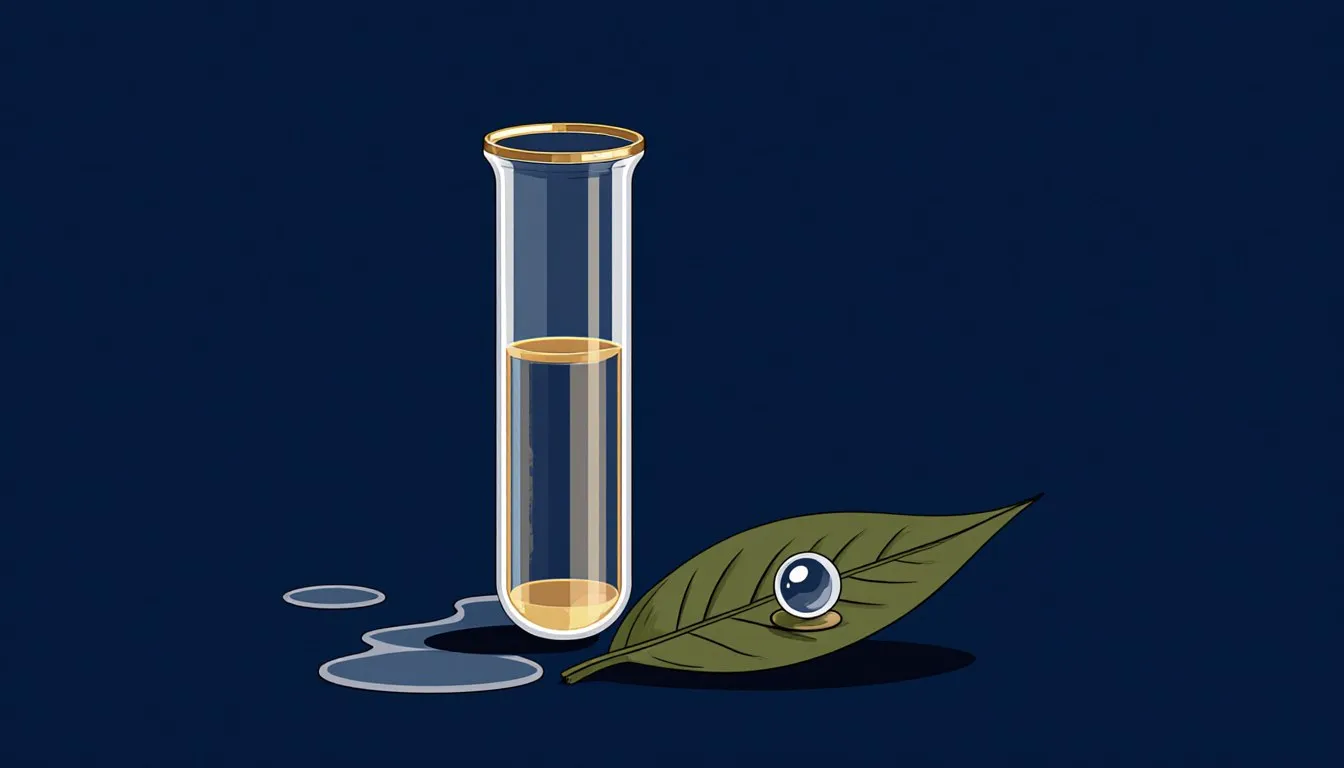
When the cohesive forces of a liquid in a narrow tube (like glass) are lower than the adhesive forces, capillary action occurs. This is true with most liquids. In case of mercury though, the cohesive forces are much higher than the adhesive forces, which is why capillary action works in reverse.
Cohesion is referred to as the inter-molecular attraction between similar molecules. Adhesion refers to the attraction between dissimilar molecules or surfaces that causes them to stick to one another.
The cohesive property in the case of solids is high, as a result of which they do not stick to the surfaces they are in contact with. Whereas, it is seen that the cohesive property in the case of gases is low or weak. Coming to the case of liquids, water is known to have both the properties of cohesion and adhesion, Thus, these two properties can be thoroughly explained in this case.
Cohesion and Adhesion in Liquids
The cohesive property of water can be observed due to the spherical shape that is formed by the molecules of water on sticking to each other. The adhesive property of water can be observed when taken in a tube as the water molecules that touch the surface of the container are at a higher level. Here the dissimilar molecules are those of water and the container.
Definition
Cohesion
◼ It is the property of the molecules of a substance to stick together. It is also referred to as cohesive attraction or cohesive force.
Adhesion
◼ It can be defined as the attraction between unlike molecules or surfaces causing them to stick to each other.
Consequence
Cohesion
◼ Surface tension, capillary action, and meniscus
Adhesion
◼ Capillary action and meniscus
Examples
Cohesion
◼ Formation of water droplets when it rains
◼ Tendency of water to bead up on the hood of a freshly waxed car
◼ Due to its effect of surface tension, some small insects like the water strides can walk on water.
Adhesion
◼ Water spreading out in a thin film of glass instead of sticking together in a ball
◼ Water drops sticking to the tip of a pine needle after rains
◼ Paper towel dipped in a glass of water wherein the water rises up the fibers of the paper
The strength of the cohesive and adhesive forces that act on the liquid is said to determine whether it will wet a surface or not. Here are the three effects of the cohesive and adhesive properties of liquids.
Surface Tension
Surface tension is a property of the surface of a liquid. It is caused by the cohesive forces resulting from the inner molecules of water that pull the molecules that are on its surface. This happens since the molecules at the surface of the liquid are not surrounded by similar molecules on all the sides, causing them to be more attracted to the adjacent molecules on the surface. The inward pull that occurs, causes the molecules to bond strongly with each other and stick weakly on the other medium. As a result, the water drops have a round or spherical shape, in turn covering a small surface area. An example of this property is the formation of water droplets.
Meniscus
Meniscus refers to the curved upper surface of a liquid in a vertical tube. A convex meniscus is obtained when the molecules in the liquid have a stronger attraction to each other i.e. cohesion, than to the walls of the container i.e. adhesion. Whereas, a concave meniscus is obtained when the molecules of the liquid have a stronger attraction to the walls of the container than to each other. A convex meniscus can be observed when mercury is taken in a glass test tube while a concave meniscus can be obtained when water instead of mercury is taken in the same.
Capillary Action
Meniscus refers to the curved upper surface of a liquid in a vertical tube. A convex meniscus is obtained when the molecules in the liquid have a stronger attraction to each other i.e. cohesion, than to the walls of the container i.e. adhesion. Whereas, a concave meniscus is obtained when the molecules of the liquid have a stronger attraction to the walls of the container than to each other. A convex meniscus can be observed when mercury is taken in a glass test tube while a concave meniscus can be obtained when water instead of mercury is taken in the same.
Both the cohesive and adhesive forces are important. One example of these forces is the transportation of water from the roots of plants to their leaves. An upward pull is created by these forces, that results from the ability of water molecules being evaporated on the plant’s surface to stay connected to the water molecules below them. In this way, water and dissolved minerals that are essential for the plants, get transported from their roots to their leaves.
Cohesion curves a meniscus into the same shape a lens uses to bend a beam, tying something as ordinary as a glass of water to light and optics.