



Specific Heat Capacity Table: Metals and Compounds in J/g K
At 25°C, water has a specific heat capacity of 4.1813 J/g K, aluminum 0.897, iron 0.450, copper 0.385, silver 0.233, and gold 0.129.
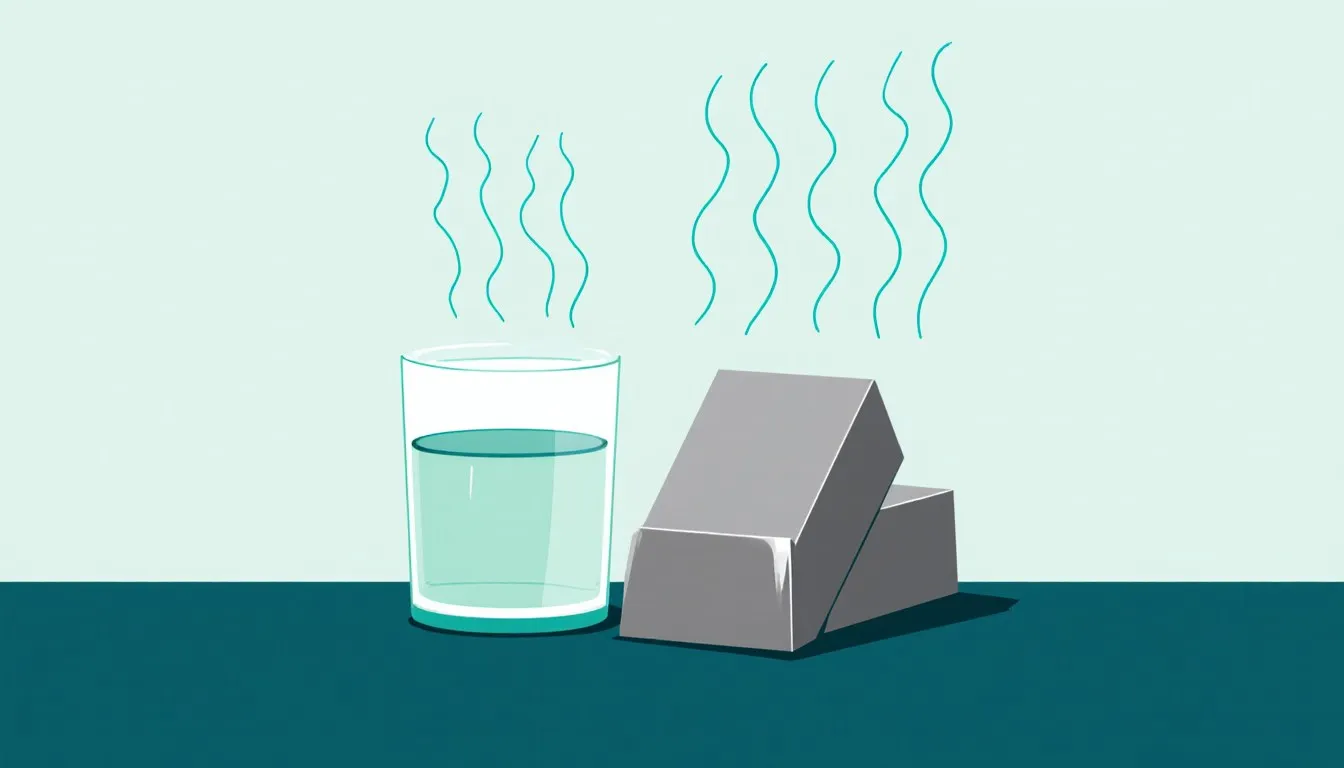
Specific heat capacity is the heat needed to raise one gram of a substance by 1° Celsius or Kelvin, measured in joules per gram per kelvin (J/g K). The most-looked-up values at constant pressure and 25° Celsius:
| Substance | cp (J/g K) | Substance | cp (J/g K) |
| Water (25° C) | 4.1813 | Aluminum | 0.897 |
| Ice (-10° C) | 2.11 | Iron | 0.450 |
| Air (0° C) | 1.0035 | Copper | 0.385 |
| Ammonia | 4.700 | Silver | 0.233 |
| Ethyl alcohol (20° C) | 2.4 | Gold | 0.129 |
Fuller tables for metals and for compounds follow further down, along with what the value actually measures.
One of the many parameters which come into play when using metals and compounds in manufacturing and chemical research, is the specific heat capacity. Be it a chemistry experiment or the use of metals in a foundry, one needs to have accurate information about the specific heat capacities of certain metals and compounds.
Definition
The specific heat capacity of a substance is the amount of heat that needs to be supplied to a unit mass of that substance to raise its temperature through 1° Celsius or Kelvin. Its value depends on internal structure of molecules that make the substance. Since temperature is a measure of the kinetic energy of a substance, the amount of heat required to raise it, is directly proportional to its internal degrees of freedom. More the degrees of freedom, more is the heat capacity of the element or compound.
This value of the heat required to raise the temperature of a single gram of any substance is either measured at constant volume or constant pressure. Both values differ substantially and the specific heat capacity at constant pressure (cp) is always greater than that at constant volume (cv). The unit used for its measurement is joules per gram degree Kelvin (J/g K). When heat capacity is measured per mole of a substance, instead of measuring it per gram, it is the molar heat capacity. This value is always larger than specific heat capacity.
Reference Table
The table presented below, provides the specific heat capacity of some metals at constant pressure (cp). The point to be noted here, is that the values presented here are those for metals, at 25° Celsius.
| Metal Element | Specific Heat Capacity at Constant Pressure (25° Celsius) J / g K |
| Aluminum | 0.897 |
| Antimony | 0.207 |
| Bismuth | 0.123 |
| Cadmium | 0.231 |
| Chromium | 0.449 |
| Copper | 0.385 |
| Gold | 0.129 |
| Iron | 0.450 |
| Lithium | 3.58 |
| Lead | 0.129 |
| Mercury | 0.1395 |
| Magnesium | 1.02 |
| Silver | 0.233 |
| Tin | 0.227 |
| Zinc | 0.387 |
| Tungsten | 0.134 |
Specific Heat Capacity Chart of Certain Compounds
It’s not possible to present values for all compounds. So I have focused on presenting values for compounds and mixtures, which are most commonly used.
| Compound/Mixture | Specific Heat Capacity at Constant Pressure (25° Celsius) J/g K |
| Air at 0° Celsius | 1.0035 |
| Ammonia | 4.700 |
| Hydrogen Sulfide | 1.015 |
| Methane at 2° Celsius | 2.191 |
| Paraffin Wax | 2.5 |
| Solid Polyethylene | 2.3027 |
| Ice (-10° Celsius) | 2.11 |
| Water (25° Celsius) | 4.1813 |
| Ethyl Alcohol at 20° Celsius | 2.4 |
If you don’t find what you are looking for, in the table presented above, I suggest that you consult scientific journals which list such parameters. Since heat capacities of compounds are not constants, you will need to refer a table of measured specific heat capacities of a substance at different temperatures, if necessary. These can only be found in science journals.
Gold warming by a degree with far less heat than water needs reveals just how unevenly heat states of matter and fluids are distributed.