
Warm Water Vibrates for Longer
Dutch researcher Arjan Lock has investigated the behavior of vibrating water molecules. Using ultra-short laser pulses, he has found that hydrogen atoms in water molecules vibrate for a longer period of time at higher temperatures, contrary to the majority of substances in which a vibration lives shorter at higher temperatures.
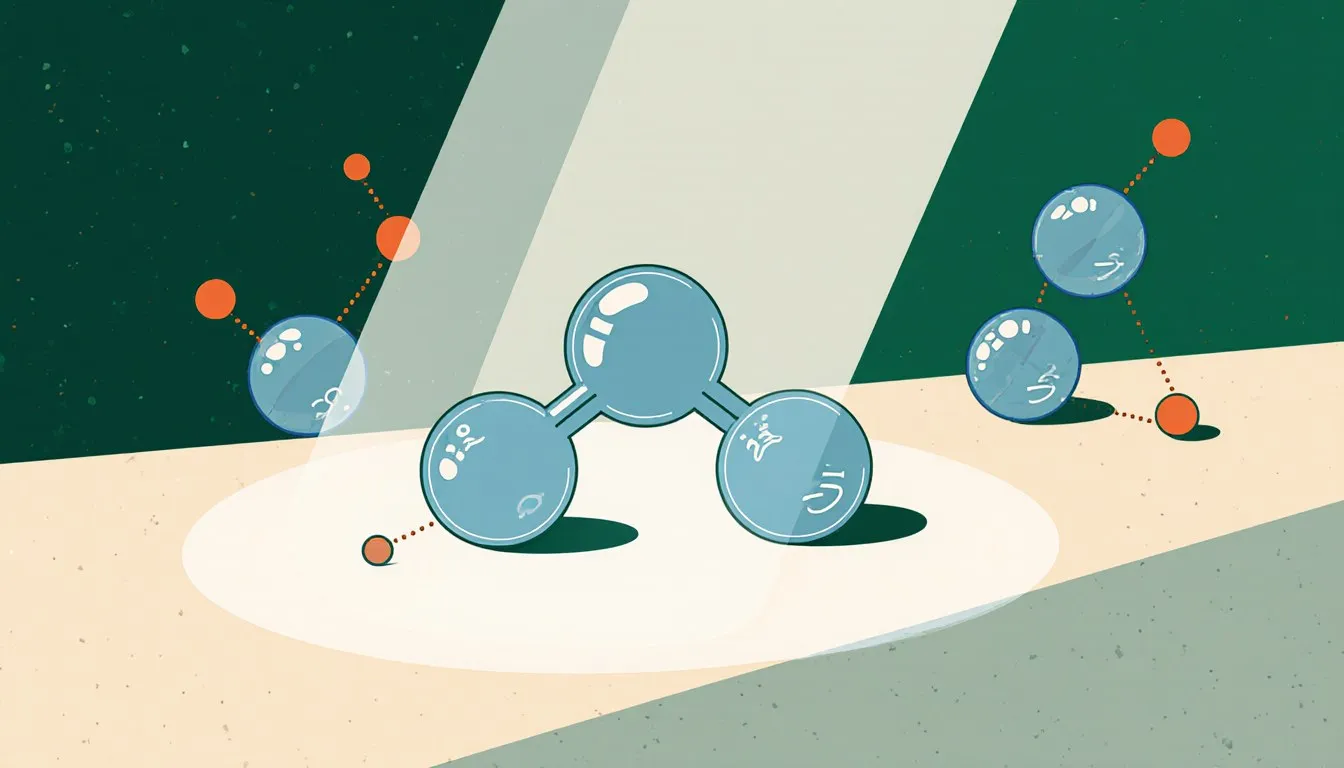
The OH-Stretch Vibration and Temperature
Lock studied the OH-stretch vibration in water. He found that the lifetime of the OH-stretch vibration, a vibration of a hydrogen atom with respect to the oxygen atom, is extremely short in water, just 0.26 picoseconds (0.26 millionth, millionth of a second). The energy is then transferred from the OH-stretch vibration to a bend vibration in water.
At a higher temperature the lifetime of the vibration increases. This is completely contrary to the expected behavior because in the majority of substances, the duration of the vibration is shorter at higher temperatures. In water however, higher temperatures weaken the hydrogen bonds and as a result of this the lifetime of the vibration increases. After a certain period of time, the hydrogen atom will stop vibrating with respect to the oxygen atom and the vibrational energy will then be transferred to other movements. The time span in which that occurs is termed the lifetime of the vibration. If the molecule has a hydrogen bond, the frequency of the OH-stretch vibration decreases and the lifetime of the vibration changes.
Hydrogen Bonds and Vibration Lifetime
The lifetime of the vibration is a measure of the strength of the hydrogen bonds. Hydrogen bonds are weak bonds between the hydrogen atom in one molecule, and the oxygen atom in another molecule. These bonds bind the individual water molecules together.
Lock used a special ultrafast infrared laser for his experiments. This laser provides extremely short light pulses: 0.2 picoseconds. As these are slightly shorter than the duration of the vibrations, they can be used to carefully follow the behavior of the vibrations.
How the Laser Experiment Worked
In the experiments the researcher used two light pulses. The first energy-rich pulse causes the molecules to vibrate. With the second pulse, Lock could examine how many molecules were still vibrating at a certain point in time after the first pulse. A water molecule that is still vibrating will not absorb the energy from the second light pulse. By measuring how much light passes through the water, the number of water molecules still vibrating can be determined.
The research was funded by the Netherlands Organization for Scientific Research.
Contact
Sonja Jacobs
[email protected]
Netherlands Organization for Scientific Research
Source
Netherlands Organization for Scientific Research
Hydrogen bonds weakening as water warms, which lets its vibrations last longer rather than shorter, count as one of the odd exceptions inside heat states of matter and fluids.