Every Mineral on Earth Belongs to One of About Eight Chemical Families
The types of minerals sort by chemistry rather than looks: silicates, carbonates, oxides, sulfides and more, with the field tests that tell them apart.
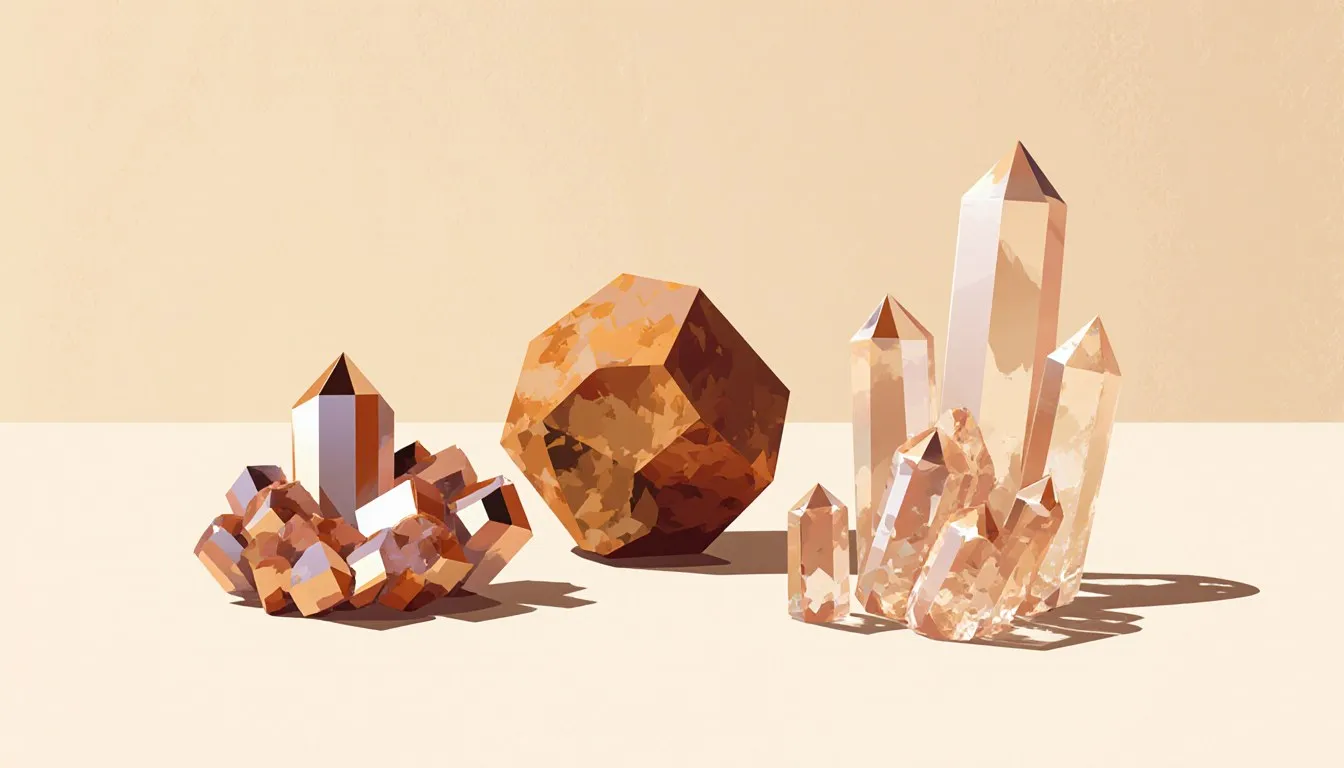
Two specimens on the same shop table can look nearly identical, brassy and heavy and faintly metallic. They can still belong to chemical families about as closely related as table salt and rust. Geologists sort minerals by the anion, the negatively charged partner in the crystal. Sort that way and the whole shelf resolves into roughly eight families rather than into colors. Silicates, carbonates, oxides, sulfides, sulfates, halides, phosphates, and native elements will cover nearly every specimen you are ever likely to pick up.
Almost everyone starts by sorting on color and shine, because that is what the eye offers first. Color is the least reliable property a mineral has. Quartz comes clear, milky, rose, smoky, purple, and yellow without changing one atom of its formula, and a trace of chromium turns a colorless aluminum oxide into a ruby. The chemistry underneath does not move around like that. Place a specimen in its family and you can predict a startling amount about it. How hard it will be. Whether it will fizz in acid. Whether it breaks along flat planes or shatters like a bottle. Even what it was doing in the rock it came out of.
What follows is the whole sorting system at overview depth: what qualifies as a mineral in the first place, why silicates own the ground under your feet, what the other families look like in the hand, and the field tests that let you tell them apart without a laboratory.
What actually makes something a mineral?
A mineral has to satisfy four conditions at once. It must occur naturally, be inorganic, have a definite chemical composition that can be written as a formula, and have its atoms arranged in an ordered, repeating crystal structure. Miss any one of those and the material is something else, however beautiful it is.
That definition is stricter than it sounds, and it quietly disqualifies a lot of things people assume are minerals:
- Amber is fossilized tree resin. Organic in origin, no crystal lattice, so it fails twice.
- Opal has a respectable formula, hydrated silica, but its silica spheres are packed without a repeating lattice. It is classed as a mineraloid.
- Obsidian is volcanic glass. It cooled too fast for atoms to line up, so it has no crystal structure at all, and it is a rock rather than a mineral besides.
- Pearl is built by a living animal out of aragonite plus organic binder. Naturally occurring, certainly. Inorganic, no.
- Synthetic ruby is chemically and structurally identical to the natural stone and still fails, because a factory is not a geological process.
Then there are the edge cases that make the definition interesting rather than tidy. Ice qualifies: it forms naturally, it is inorganic, it is H2O, and it has a hexagonal lattice. Liquid water does not, because the lattice is gone. Native mercury is liquid at ordinary temperatures and gets counted anyway, by long convention. Every definition worth having has a few cases sitting on the fence, and the fence is usually where the good questions live.
One more distinction, because it trips up more beginners than any other. A mineral is a single substance with one formula. A rock is an aggregate of minerals. Granite is not a mineral; it is a mixed assembly of quartz, feldspar, and mica that you can pick apart with your eye if the grains are coarse enough. When someone hands you a specimen and asks what mineral it is, the first honest answer is sometimes that you are holding three of them.
How do geologists sort minerals into types?
Classification runs on chemical composition first, structure second, and appearance essentially not at all. The organizing principle is the anion or anionic group: carbonate minerals are the ones built around CO32-, sulfides around S2-, silicates around the silicon-oxygen unit, and so on down the list. The metal cation bonded to that group varies enormously and matters much less for family membership than most people expect.
This is why calcite (CaCO3) and siderite (FeCO3) sit together as carbonates despite one being pale and the other rusty brown, while pyrite (FeS2) and hematite (Fe2O3) sit in different families despite both being iron minerals. Family membership follows the anion, so the iron in pyrite and the iron in hematite land in different classes.
Most working mineralogists use the Nickel-Strunz classification. The older Dana system does the same job with a different numbering. Both sort on the anion, and both run finer than a beginner needs, splitting each family into subgroups and then into individual species. The eight families in this article are the common trunk of that scheme, with the smallest and least commonly encountered groups folded in, which is the version worth carrying in your head.
The body that decides what counts as a species at all is the International Mineralogical Association, through its Commission on New Minerals, Nomenclature and Classification. Nothing becomes an official mineral because a collector says so. A proposed species needs a described chemistry, a solved crystal structure, and an approved name before it enters the catalog. The same commission also discredits older names now and then, when one turns out to describe something already on the list under another label.
Worth noticing what did not make the sorting criteria: color, luster, hardness, crystal shape, and how expensive the specimen was. Those are all identification tools, and excellent ones. They are how you work out which family you are holding, which is a different job from deciding what the family is.
Why do silicate minerals dominate almost everything you step on?
Silicates make up roughly ninety percent of Earth’s crust by volume, for the plain reason that oxygen and silicon are the two most abundant elements in it. When molten rock cools, those two are simply what there is most of, and they combine into a unit so stable that it becomes the structural basis for the entire crust.
That unit is the silicon-oxygen tetrahedron, written SiO44-. One small silicon atom sits at the center. Four oxygen atoms sit at the corners of a pyramid around it, the kind with a triangular base. Think of it as a building brick with four studs. The analogy gets you started and then breaks, in a way worth knowing: bricks stack, while tetrahedra share corner oxygens with each other. Two neighboring tetrahedra can use the same oxygen atom, and the number of corners they share is what sets the entire architecture of the mineral.
Share none of them, and you get isolated tetrahedra with metal ions packed between, which is olivine, the green mineral that makes up most of the upper mantle. Share two corners, and the tetrahedra link into long single chains, which is the pyroxene group. Share alternating corners between two parallel chains, and you get the double chains of the amphiboles, hornblende being the common one. Share three, and the chains flatten out into continuous sheets. That is mica. It is also why a mica flake peels: the sheets are strongly bonded within themselves and weakly bonded to each other. Share all four, and the structure closes into a rigid three-dimensional framework in every direction. That is quartz, and it is also why quartz has no cleavage planes and simply fractures in curved conchoidal shells instead.
Three silicates account for most of the ground you will ever walk on:
- Feldspar is the most abundant mineral group in the crust, more than half of it by volume. It comes in two branches, the potassium feldspars and the sodium-calcium plagioclase series. In a hand specimen, look for blocky crystals, two cleavage directions meeting at close to a right angle, and a hardness of about 6.
- Quartz is pure SiO2, hardness 7, glassy, no cleavage, and chemically stubborn enough that it survives weathering after everything around it has broken down. That survival is why beach sand is mostly quartz.
- Mica splits into transparent elastic sheets you can peel with a fingernail. Muscovite is the pale one, biotite the dark one.
The clay minerals belong to this family too, as sheet silicates that have been chemically broken down and rebuilt at low temperature. So do beryl, tourmaline, garnet, topaz, and zircon. When a student tells me the silicate section looks like the boring one, I point out that it contains both the sand on the beach and the emerald in the case, and that the difference between them is which metal ions wandered into the framework.
What are the other major mineral groups?
The remaining families make up about ten percent of the crust and a far larger share of what anyone actually collects, mines, or notices, because non-silicates are where the ores, the gemstones, and the household chemicals live. One clear example per family is more useful than a long catalog.
| Family | Defining unit | Everyday example | What gives it away |
|---|---|---|---|
| Silicates | SiO4 tetrahedron | Quartz, feldspar, mica | Hard, glassy, everywhere |
| Carbonates | CO32- | Calcite (CaCO3) | Fizzes in dilute acid, hardness 3 |
| Oxides | O2- | Hematite (Fe2O3) | Red-brown streak, heavy for its size |
| Sulfides | S2- | Pyrite (FeS2) | Metallic luster, dark streak, often cubic |
| Sulfates | SO42- | Gypsum (CaSO4·2H2O) | Soft enough to scratch with a fingernail |
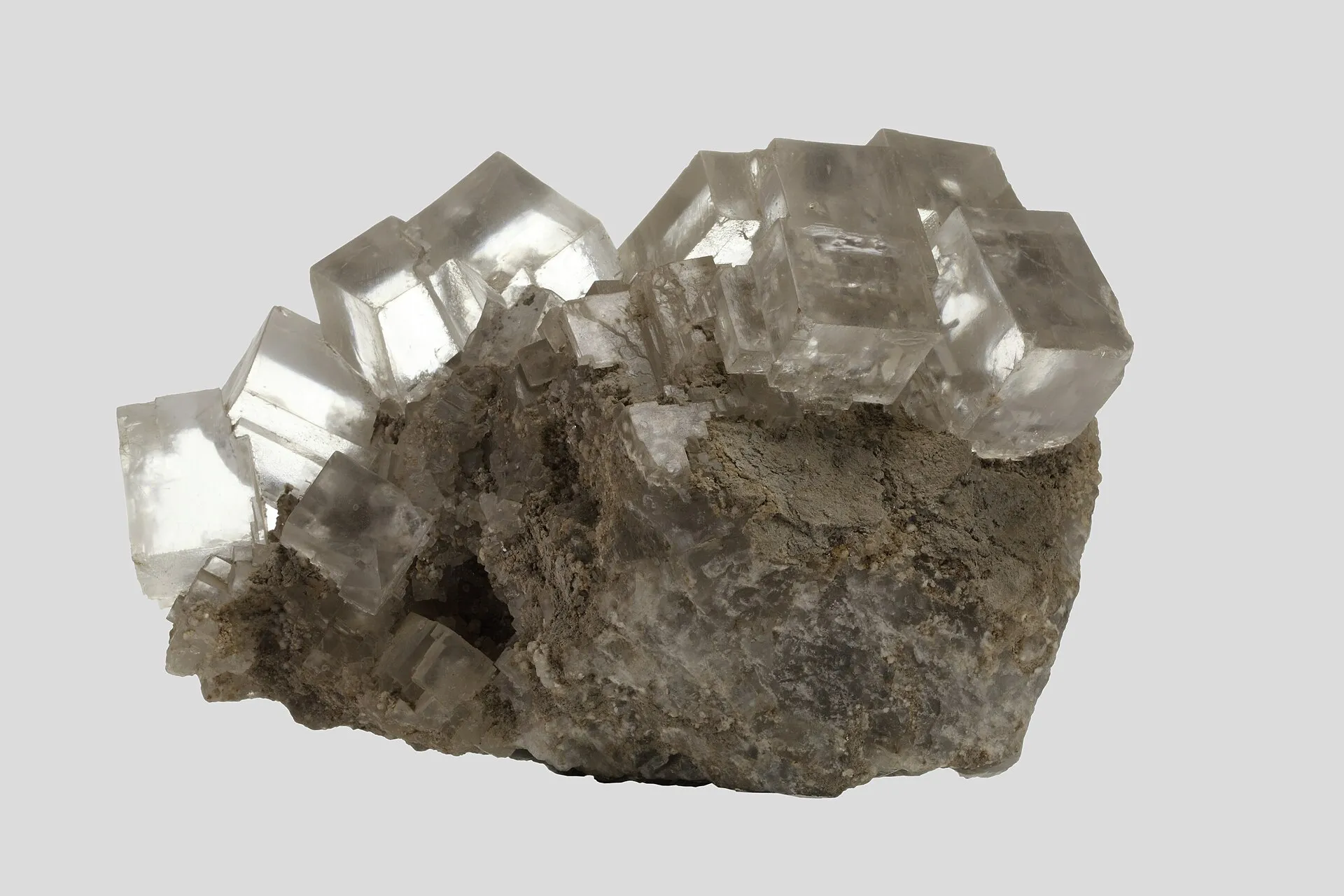
| Halides | Cl-, F-, Br-, I- | Halite (NaCl) | Cubic cleavage, dissolves in water |
| Phosphates | PO43- | Apatite | Hardness 5, hexagonal prisms |
| Native elements | none, one element only | Gold, copper, sulfur | Malleable metals or bright yellow crusts |
Carbonates
Built on the carbonate ion, and the easiest family to confirm in the field. If you keep a dropper bottle for the field test, keep the acid dilute, keep it capped, wear eye protection, and never mix your own without knowing the dilution order: acid into water, like you oughta, never the reverse. Put a drop of dilute acid on calcite and it fizzes carbon dioxide on the spot. Household vinegar on a freshly broken chip will do the same job more slowly, which is enough to settle the question when there is no acid on the shelf. Calcite is the mineral of limestone, marble, chalk, and every stalactite in every cave. Aragonite has the identical formula and a different structure. Dolomite adds magnesium and is notably reluctant to fizz unless you powder it first, which is a genuinely useful field distinction.
Oxides
A metal bonded straight to oxygen, and the family that has supplied most of the world’s iron. Hematite looks silvery-black or earthy red and always leaves a red-brown streak. Magnetite is magnetic strongly enough to swing a compass needle. Corundum is aluminum oxide, hardness 9, and appears as both ruby and sapphire depending on the trace impurity. Ice, when you think about it properly, is an oxide of hydrogen.
Sulfides
Metal bonded to sulfur, and the family that includes most metal ores plus the single most misidentified mineral on Earth. Pyrite is brassy, brittle, hardness 6 to 6.5, often grows in beautiful striated cubes, and leaves a greenish-black streak. Gold is soft, hardness about 2.5 to 3, dents rather than shatters under a pin, and streaks yellow. Galena is lead sulfide, breaks into perfect little cubes, and feels shockingly heavy in the hand. Handle sulfides with respect and wash your hands afterward: galena is lead, cinnabar is mercury sulfide, and realgar and orpiment are arsenic sulfides. Never heat a sulfide specimen, which drives off sulfur dioxide, and never let a young collector taste-test anything.
Sulfates
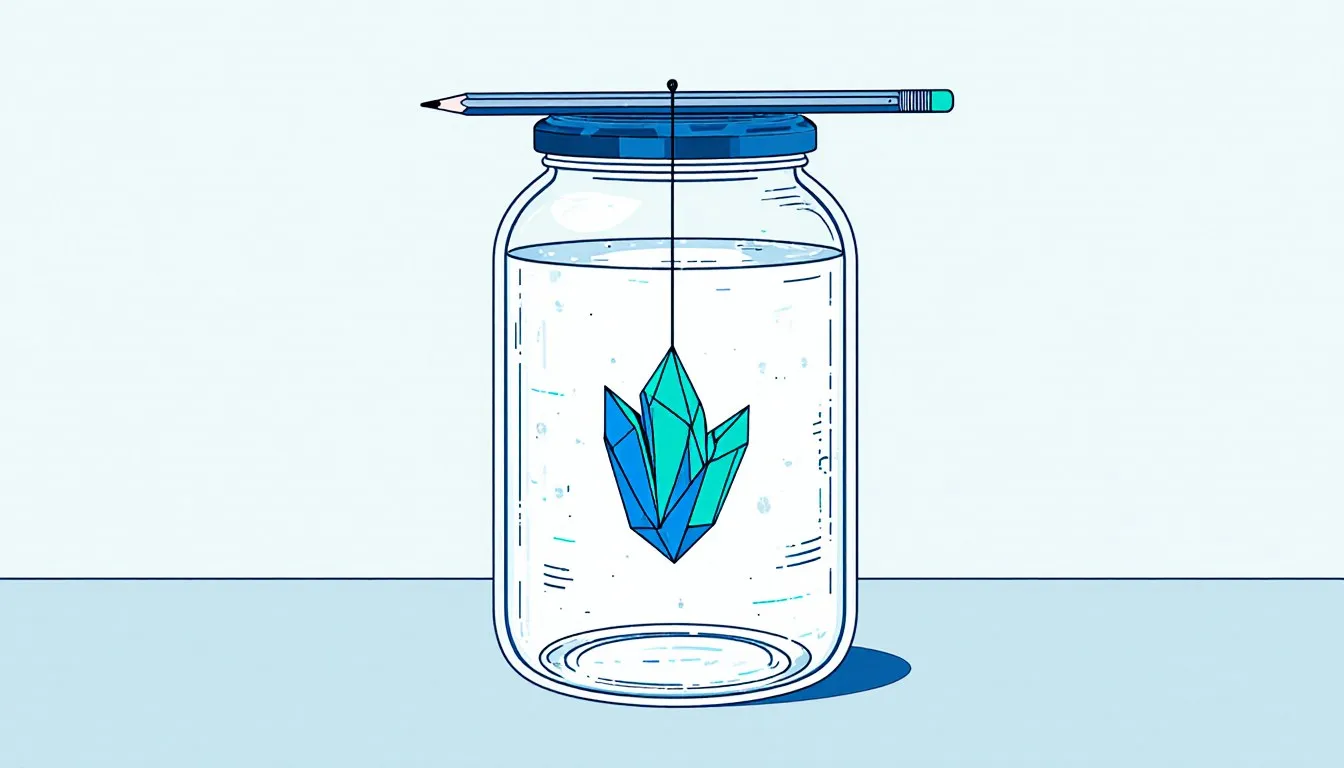
Built on the sulfate ion, usually formed where mineral-rich water evaporated. Gypsum is soft enough to scratch with a fingernail and turns into plaster of Paris when heated hard enough to drive off its water of crystallization. Barite is dense out of all proportion to its dull appearance. Potassium alum is a sulfate too, and it is the one family member most people meet in a classroom rather than a quarry, because a saturated alum solution will grow clean octahedral crystals on a string in a few days.
Halides
A metal bonded to a halogen. Halite is sodium chloride, the rock salt on winter roads and in the grinder. Fluorite is calcium fluoride, hardness 4, cleaves into octahedra, and gave its name to fluorescence after mineralogists noticed specimens glowing under ultraviolet light. Halides tend to be soft and many of them dissolve, which is why they survive only in dry settings.
Phosphates
Built on the phosphate ion. Apatite is the common one, sitting at 5 on the hardness scale, and closely related phosphate minerals form the hard mineral component of vertebrate bone and tooth enamel. Phosphate rock is also the raw material for most agricultural fertilizer, which makes this quiet family more economically load-bearing than the shiny ones.
Native elements
A single element in an uncombined state: gold, silver, copper, platinum, sulfur, and both carbon polymorphs, graphite and diamond. These are the minerals that gave early metallurgy its start, because a lump of native copper can be hammered into a shape with no smelting at all.
Two smaller families round out the formal scheme. Borates include borax, which comes from evaporated desert lake beds. Organic minerals are crystalline compounds of geological origin with carbon in an organic arrangement, such as whewellite. They are real, they are rare, and outside a serious collection you will not meet one.
Does crystal structure really change what a mineral is?
It changes it completely, and the clearest proof is that two minerals with identical formulas can be different species. Diamond and graphite are both pure carbon. One is the hardest natural substance known. The other will slide off onto your fingers. The whole difference is the bonding. Diamond ties each carbon to four neighbors in a rigid three-dimensional network. Graphite lays them out in flat sheets, and the sheets are held together weakly. Same formula, different arrangement, different mineral. Mineralogists call these polymorphs, and calcite and aragonite are another pair, as are pyrite and marcasite.
Underneath every crystal is a lattice, a pattern of atoms repeating in three dimensions. Those lattices fall into six or seven systems, depending on whether you count trigonal separately from hexagonal. The systems are cubic, tetragonal, orthorhombic, hexagonal, monoclinic, and triclinic, and they describe the symmetry of the repeating unit rather than the shape of any particular specimen.
- Cubic: halite, pyrite, fluorite, garnet, diamond. Three equal axes at right angles.
- Hexagonal and trigonal: quartz, calcite, beryl. Six-fold or three-fold symmetry about one main axis.
- Tetragonal: zircon, rutile. Square cross-section, one axis a different length.
- Orthorhombic: olivine, barite, topaz. Three unequal axes, all at right angles.
- Monoclinic: gypsum, mica, orthoclase feldspar. One axis tilted.
- Triclinic: plagioclase feldspar, kyanite. No axis at a right angle to any other.
The outward shape, called the habit, follows from the lattice but does not always advertise it. A halite crystal grown slowly makes obvious cubes; halite grown in a hurry can look like nothing much. Growing alum crystals is the cleanest way I know to watch a lattice assert itself in real time, because the octahedra come out of solution over a few days on a kitchen windowsill and the faces meet at angles you can measure with a protractor. Step by step, our guide to growing alum crystals walks through the full method, and a separate piece on alum crystals facts covers what the compound itself is and how it behaves.
The ordered lattice is also the exact line between a mineral and an amorphous solid. Window glass has silicon and oxygen in roughly the right proportions and no long-range order at all. Its atoms sit frozen mid-jumble, the way they sat in the melt. So the line between cut glass and a true crystal is drawn at the lattice, and sparkle tells you nothing about it: leaded glass throws light beautifully and its atoms are still a frozen jumble. Glass is an amorphous solid, rigid all the way through, and the old story that antique window panes are thicker at the bottom because glass slowly flows is simply wrong. Those panes came off the crown-glass table at uneven thickness and were installed heavy end down, which is the sensible way to hang a wobbly sheet of glass.
How do you tell one mineral type from another by eye?
Five tests will place most specimens, and none of them requires a laboratory. Run them in roughly this order, because each one narrows the field for the next.
| Test | What it measures | How to run it | Reliability |
|---|---|---|---|
| Hardness | Resistance to scratching | Mohs scale, 1 (talc) to 10 (diamond) | High |
| Streak | Color of the powdered mineral | Drag across unglazed porcelain | Very high |
| Luster | How the surface returns light | Metallic or non-metallic, then a subtype | Moderate |
| Cleavage or fracture | How the crystal breaks | Count flat planes and the angles between them | High |
| Specific gravity | Density relative to water | Heft it, or weigh it in and out of water | Moderate by hand |
| Color | Wavelengths reflected | Look at it | Low |
Hardness uses the Mohs scale, which runs talc 1, gypsum 2, calcite 3, fluorite 4, apatite 5, orthoclase 6, quartz 7, topaz 8, corundum 9, diamond 10. It is an ordinal scale, not a linear one, which students always underestimate: the jump from corundum to diamond is vastly larger than the jump from talc to gypsum. A field kit hiding in your pocket already: a fingernail scratches to about 2.5, a steel nail or knife blade to about 5.5, and a glass plate is about the same. Modern pennies are copper-plated zinc, so the old copper-coin test at 3.5 is no longer trustworthy. Always scratch the unknown with the known, then wipe the mark and check whether it is a real groove or just metal smeared on the surface.
Among quick tests, Streak is the one to trust most, because the powdered color of a mineral stays constant even when the specimen color does not. Hematite can be black, silvery, or brick red and always streaks red-brown. Pyrite streaks greenish-black, gold streaks gold. The limitation is honest and worth stating: a streak plate is about 6.5 on Mohs, so anything harder simply scratches the plate and leaves white porcelain dust that means nothing.
Luster splits first into metallic and non-metallic and then into subtypes: glassy, pearly, silky, resinous, earthy, adamantine. Non-metallic is a wide field, so treat luster as a narrowing tool rather than an answer.
Cleavage versus fracture reads the bonding directly. Cleavage means the crystal breaks along planes where the bonds are weakest, producing flat reflective surfaces, and both the number of planes and the angles between them are diagnostic. Mica has one perfect cleavage, halite and galena have three at right angles giving cubes, calcite has three not at right angles giving rhombs, and fluorite has four giving octahedra. Fracture means no preferred plane at all: quartz breaks in curved conchoidal shells like a bottle bottom, because its framework is equally strong in every direction.
Specific gravity is density compared with water, and after handling a few dozen specimens your hands get startlingly good at it. Galena feels wrong the first time you lift it, in the way a lead fishing weight feels wrong. If you go past hefting and start calculating, metric does most of the work for you. Grams divided by millilitres gives you specific gravity directly, since a millilitre of water weighs a gram. Ounces and cubic inches will get you there too, but only after a conversion you have to remember to do.
A few extras earn their place. Calcite fizzes in dilute acid. Magnetite grabs a magnet. Some fluorite and calcite specimens glow under ultraviolet light. Halite is famously identified by taste, and I will say plainly that taste-testing belongs only to labelled specimens of known origin and never to a field find or a child’s collection. Halite under this exact set of tests makes an excellent first exercise, and our roundup of salt crystals facts follows that one familiar mineral from the shaker back to the deposit it came out of.
Where do new mineral types come from, and how many exist?
The catalog runs to well over five thousand recognized species, and it grows by something on the order of a hundred new approvals in a typical year. Only about a hundred of those species are common enough that a working geologist meets them regularly. A large share are known from a single locality, sometimes from a single specimen, which is why a well-stocked museum drawer can hold minerals that most professionals will never see in the field.
Which mineral crystallizes out of a given setting depends on three things: which elements are present, the temperature, and the pressure. Change any one and you get a different species from the same ingredients. Slow cooling deep underground gives magma time to grow large crystals, which is why granite is coarse and the volcanic rock from the same melt is fine-grained. Bury a mudstone and squeeze it, and you grow entirely new metamorphic minerals in the solid state, garnet and kyanite and staurolite among them. Evaporate a salt lake and the dissolved load crystallizes out in a predictable sequence as the water disappears, carbonates first, then sulfates, then halides. Push hot mineral-charged water through a fracture and it deposits an ore vein along the walls as it cools.
One good argument comes from the mineral evolution work of Robert Hazen and colleagues. It holds that most known mineral species exist only because life oxygenated the atmosphere. Before free oxygen, the planet had a far shorter list. Oxidation opened up thousands of new chemical possibilities, which puts the contents of a museum drawer in an unexpectedly biological light.
Not every element joins in. The noble gases form essentially no minerals at all, because a full outer electron shell leaves them with no reason to bond to anything. Krypton and its relatives stay dissolved, trapped in pore spaces, or simply gaseous rather than locking into a lattice. Look at the physical and chemical properties of krypton and the electron configuration does all the explaining on its own. Carbon, sitting at the opposite extreme with four bonding electrons and a talent for chains and networks, turns up in hundreds of species and in two very different pure forms.
Does “mineral” mean something different in nutrition?
It does, and the overlap causes real confusion. When a nutrition label lists calcium, iron, potassium, or zinc as minerals, it means dietary minerals. Those are chemical elements the body requires, and they arrive as dissolved ions rather than as crystals. The iron on that label is measured in milligrams; the iron in a hematite specimen is measured by the fistful. That sense of the word has nothing to do with crystal structure, formation environment, or the International Mineralogical Association’s catalog.
The two senses do touch at the edges. The calcium in a limestone cliff and the calcium in a bone are the same element, and the sodium chloride in a rock salt deposit is the same compound as the salt in a shaker. But an element dissolved in your bloodstream has no lattice and is not a mineral in the geological sense at all. Which sense a label means depends on the discipline you are standing in. Both fields inherited the word from the medieval sense of anything dug out of a mine. That older meaning is why a bottle of mineral water is labelled by the dissolved ions it carries, with nothing crystalline in it at all. Anything to do with intake, deficiency, or supplementation is a medical question and belongs with a qualified professional, not with a rock hammer.
Why bother knowing the types at all?
Because the sorting turns a shelf of pretty objects into something you can read, and because the system extends well past the rock shop. The granite countertop in a hardware store is a silicate assembly, and if the grains are coarse you can pick out the glassy grey quartz, the blocky pink or white feldspar, and the black flakes of mica that catch the light when you tilt your head. The bag of rock salt in the garage is halite, a halide, cleaving into little cubes when you crush a lump. A cave photograph is carbonate chemistry running in slow reverse. The magnet on the refrigerator descends from an oxide someone noticed swinging a compass needle.
The table above is the whole scheme on one page, and it is worth a second look next time a specimen is sitting in your hand: work down it, family by family, and let the fizz test or the streak plate or the cleavage angles do the narrowing. You will be wrong sometimes. Everyone is wrong about pyrite at least once.
The next question is where those families come from, which is really a question about rocks rather than minerals: what heats, buries, melts, and dissolves the crust well enough to grow one family here and another one a mile away. Start with a windowsill full of alum solution and a piece of string, watch a lattice build itself over four days, and the rest of the crust starts looking a good deal less random.
Nora Whitfield
Staff Writer
Nora Whitfield taught high-school chemistry and physics for twenty-eight years, and she has never once answered "when will I use this?" with a sigh. She believes any honest question about how the world works deserves an answer that is both correct and actually understandable.