A Science Fair Project Is a Question You Test, Not a Thing You Build
Most science fair projects lose points before the fair starts. A teacher explains what makes a project testable, how to run it, and what judges reward.
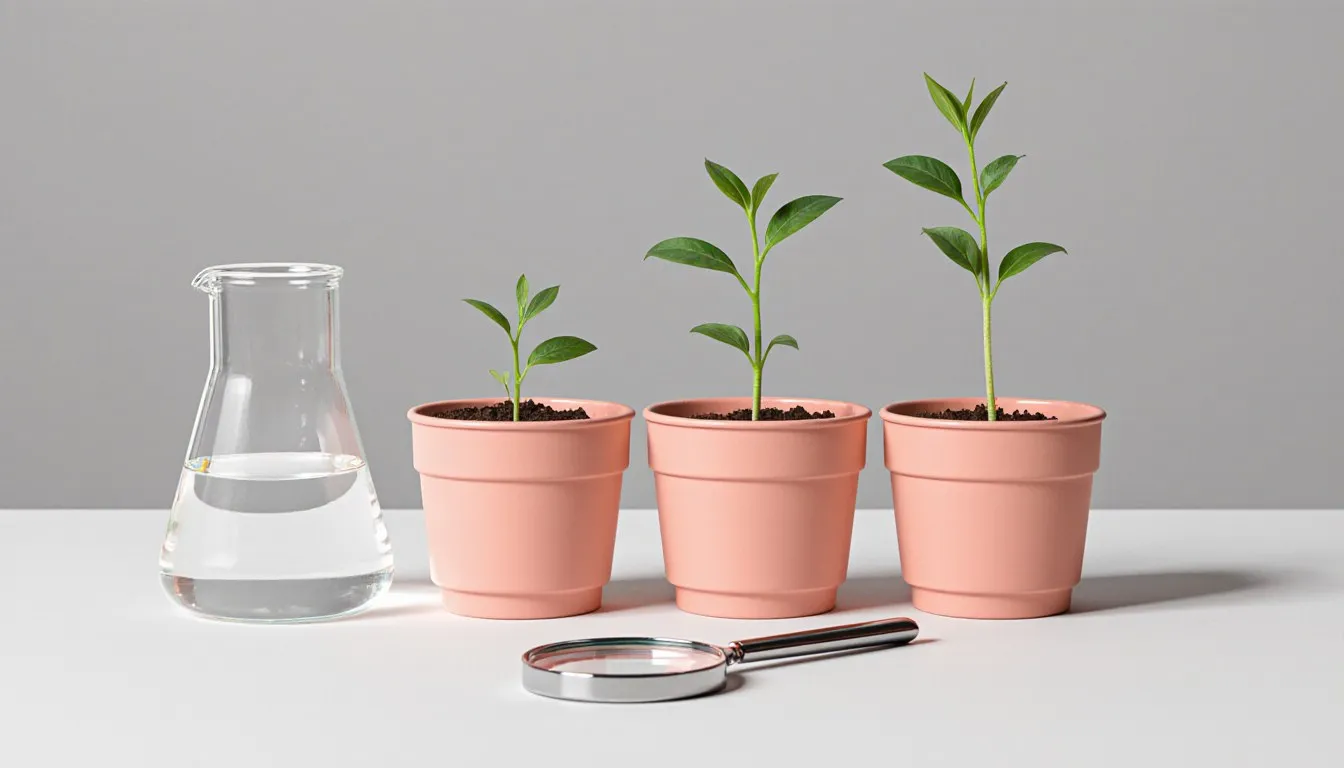
In twenty-eight years of walking gym floors on judging day, the boards I remember hardest are the gorgeous empty ones. A papier-mâché volcano that erupted on cue. A poster of nine planets in careful gel pen. A working hydraulic arm, hinged and painted, with no data table anywhere on the board. Weeks of work in each, and a judge can grade none of it, because there is no number on the board that could have come out otherwise. Two tables down sat a lopsided tri-fold from a kid who wondered whether paper towels absorb more water when they’re warm, tested it eleven times, and wrote every reading down. That board placed.
A science fair project answers a question by measuring something. That’s the whole hinge. The build, the poster, the glitter glue, all of it exists to serve a measurement, and when there’s no measurement underneath, the project has nothing for a judge to grade except craft. Below is the full arc, from a vague interest to a board on a folding table: how to find a question you can actually test, how to run it the way a scientist would, how expectations shift as a student moves up through the grades, and what actually happens in the two to four minutes a judge spends in front of you.
What actually makes something a science fair project instead of a demonstration?
Three things, and a project missing any one of them is a demonstration wearing a project’s clothes: a testable question, one variable you deliberately change while holding everything else steady, and repeated measurements you write down.
Here’s the misconception, and it’s the most common one at any fair in the country: people believe a science fair project is something you make. Ask a room of sixth graders what they’re doing for the fair and you’ll hear nouns. A volcano. A solar system. A model of the human heart. Nouns are demonstrations. They show a thing that is already known to be true, and they show it the same way every time, which means there is no result, because a result is something that could have come out otherwise.
A project is a sentence with a verb and an unknown in it. Does baking soda concentration change how high the eruption goes? That is the volcano, converted. Same materials, same mess, entirely different piece of work, because now there is a number that could surprise you.
The test I gave my own students: before you touch a single supply, can you name the thing you’re going to measure and the unit you’ll measure it in? Height in centimeters. Time in seconds. Mass in grams. Count of colonies. If the answer is “I’ll see what happens,” you have a craft project. If the answer is “eruption height, in centimeters, from the rim of the bottle,” you have an experiment, and everything after that is just doing it carefully.
The three pieces, plainly:
- A testable question: one you could answer wrong. “How do volcanoes work?” cannot be answered wrong; it can only be researched. “Does vinegar temperature affect eruption height?” can come out the opposite of what you expected, which is exactly what makes it worth doing.
- A controlled variable structure: one thing changes (the independent variable), one thing gets measured (the dependent variable), everything else is held identical on purpose and listed on the board.
- Repeated trials with recorded data: numbers in a table, in the order you took them, including the trial that went sideways.
That last clause matters more than students expect. The trial that went sideways is evidence. Erasing it is the one dishonest thing you can do at a science fair, and judges notice suspiciously clean data faster than they notice a crooked title.
Why does the scientific method matter more than the topic you pick?
Because the method is the machine, and the topic is only what you feed into it. I have watched a project about which brand of chewing gum keeps its flavor longest score higher than a project on solar panel efficiency, for the plain reason that the gum student ran nine trials with a stopwatch and a rating scale and the solar student measured one panel once on a cloudy Tuesday. The machine image has a limit worth naming, though. Nothing about the method runs on its own, and it gives you no protection at all if you picked the wrong quantity to measure in the first place. Follow all seven steps faithfully on a measurement that can’t answer your question and you get a tidy, useless result.
The steps, briefly, because a hands-on breakdown of each one is a subject of its own and scientific method activities cover the drills if you want to practice the moves:
- Question. Narrow enough to measure. “Which surface in my house has the most bacteria” beats “are germs bad.”
- Background. Twenty minutes of reading so you’re not re-deriving something settled. This also tells you what to expect, which is what makes a hypothesis a prediction rather than a guess.
- Hypothesis. A prediction with a reason attached. Not “I think warm water will dissolve sugar faster” but “I think warm water will dissolve sugar faster because heat gives the water molecules more energy to break the sugar crystals apart.” The reason is the part that gets graded.
- Variables. Name your independent variable (what you change), your dependent variable (what you measure), and your controls (what you hold still). Write them on the board in those words. Judges look for those words.
- Procedure and trials. Written so a stranger could repeat it. Three trials minimum per condition; five is better; more is better still if time allows.
- Results. Data table first, then a graph that shows the same data in a shape the eye can read.
- Conclusion. Did the data support the hypothesis, and what would you do differently. A conclusion that says “my hypothesis was wrong, and here’s what I think happened instead” is a strong conclusion, not a failed one.
Notice what the method buys you. It converts an opinion into a claim somebody else can check. That is the entire reason it exists, and it’s why a kid who runs the method properly on chewing gum is doing more real science than a kid who builds an impressive-looking apparatus and never varies anything.
One structural note that saves grief: decide the procedure before the first trial, and don’t improve it midstream. The moment you change your method on trial four, trials one through three are measuring a different experiment and you cannot honestly average them together.
How do you choose a project idea that’s actually yours?
Start with something that has bugged you for a while, and beware the idea you picked because it looked good on a list.
I could always tell. A student would present a project on the effect of magnetic fields on seed germination, and I’d ask why they chose it, and the answer would be some version of “it was on the website.” A borrowed topic holds up fine right until the data comes out flat. At that point the student has no instinct for why, no follow-up question, and nothing to say to a judge beyond reciting the board back at them.
The one-sentence test works better than any brainstorming worksheet: can the student explain the whole project in one sentence, out loud, without notes, to somebody who doesn’t do science? “I’m testing whether the water in my fish tank stays cleaner with more plants in it.” That kid will be fine. If it takes three sentences and a diagram to explain what they’re even asking, the project is too complicated, and complicated projects fail in a predictable way: they run out of time, produce partial data, and get defended badly.
Some places a question of your own comes from, all of which beat a list:
- An argument in your house. Somebody insists the microwave popcorn burns on the preset button. Test it.
- Something you do a lot. Athletes have real questions about grip, bounce, drag, and recovery. Musicians have real questions about string tension and humidity. Gamers have real questions about reaction time.
- Something that costs money. Does the expensive battery actually last longer? Does the pricier plant food do anything a cheap one doesn’t? Comparison projects are respectable science and the results are frequently the fun kind, meaning not what the packaging promised.
- Something you noticed and can’t explain. The best category. Why does the sidewalk on one side of the street stay icy longer? Why does bread mold faster in one part of the kitchen?
Parents, a word. Your job is transportation, supervision, and asking “how will you measure that?” until the student has an answer. It is not designing the experiment. Judges can spot an adult’s hand in a project from across a gymnasium, usually in the vocabulary on the board, and it costs more points than a wobbly graph ever did.
What changes about a good project from grade to grade?
The method stays identical from third grade to twelfth. What scales is the number of variables in play, the precision of the measurement, and how much of the design the student did alone.
Roughly how the expectations climb, in the shape most fairs and most standards-aligned rubrics use:
- Elementary (about grades 3 to 5). One independent variable, an obvious dependent variable, three trials, measurement with everyday tools: a ruler, a kitchen scale, a stopwatch, a count. The student should be able to say which thing they changed and which thing they measured. Adult help with materials and safety is expected and fine. The hard part at this age is finding something a nine- or ten-year-old can measure without an adult holding the ruler. The 4th grade science projects that work are usually a straight comparison of two or three things, counted or timed, with the whole procedure fitting on one index card. A year later I want a little more, and the 5th grade science fair projects that place tend to show it: trials averaged, and a line on the board naming what was deliberately held still.
- Middle school (about grades 6 to 8). A real control group, five or more trials, averages, a graph the student chose the type of, and the beginnings of error discussion: what could have gone wrong, and what they’d tighten next time. Measurement gets more precise, a graduated cylinder instead of a measuring cup, a digital scale reading to a tenth of a gram. The specific idea territory at each of those years is covered in 6th grade science experiments, 7th grade science fair projects, and 8th grade science fair projects.
- High school. Independent design, quantified uncertainty, sample sizes big enough to mean something, and a literature background that cites real sources. This is also where regulated categories arrive: anything involving human subjects, vertebrate animals, or hazardous materials needs approval paperwork before you start, and the International Science and Engineering Fair rules are the model most regional fairs follow. Capstone-scale work has its own considerations, and the senior project topics worth attempting at that level are a subject of their own.
Two things that do not scale with grade level, and I’ll defend both: the requirement that the student can explain their own project, and the requirement that the data is honest. An eighth grader with a rigorous three-variable design who can’t say why they used a control group is behind a fourth grader who can.
One more thing worth knowing about the modern rubric. Under the Next Generation Science Standards framework most states now use, the emphasis sits on science and engineering practices, planning investigations, analyzing data, constructing explanations from evidence, rather than on knowing facts. That’s why a fact-report board scores so poorly now even when the facts are all correct. It isn’t demonstrating a practice.
Experiment, invention, or model: how do you pick the right category?
Check your fair’s entry form first, because most fairs judge these on separate rubrics, and a project entered in the wrong category gets measured against criteria it was never built to meet.
The three shapes, and how each one is graded:
- The experiment. You have a question, a hypothesis, controlled variables, and data. Graded on experimental design and the quality of your reasoning from the data. This is the default and the safest category if you’re unsure.
- The engineering or invention entry. You have a problem, a design, and a build that you tested and revised. Graded on the design cycle: did you define the need, set criteria for success, prototype, test against those criteria, and improve? The key difference is that a hypothesis is replaced by a performance target. “My water filter should remove visible sediment from a liter in under two minutes” is the engineering version of a hypothesis, and you still take measurements, still run trials, still record failures. A mousetrap car or a CO2 dragster is engineering, not experiment, unless you deliberately vary something (wheel diameter, axle friction) and measure the effect, at which point it becomes both. If the build path is where your interest is, invention ideas for school projects and invention convention ideas cover that route.
- The model or display. A grassland ecosystem diorama, a solar system build, a working heart model. These teach the maker a great deal and photograph beautifully, and at most competitive fairs they score lowest, because there’s no investigation to judge. Where they belong is a classroom display night, a lower-elementary showcase, or a fair that explicitly runs a display category. Don’t bring one to a judged experimental fair and expect it to compete.
The unhappiest conversations I ever had on judging day were with students who’d built something genuinely impressive and entered it against experiments. The work was real. The rubric simply had no box for it. Read the entry form.
What do science fair judges actually look for on judging day?
Whether you understand your own project. Everything else on the rubric is downstream of that.
Here is what the encounter really looks like. A judge has maybe two to four minutes with you, possibly less at a crowded fair. They will glance at the board while you talk. They will ask you two or three questions. In my experience of both sides of that table, the questions are almost always some version of these:
- What made you pick this?
- What did you change, and what stayed the same?
- Why did it come out this way?
- What would you do differently if you ran it again?
The third one separates the field. A student who says “I don’t know, that’s just what happened” has stopped being a scientist at the exact moment it got interesting. A student who says “I expected the darker fabric to heat up more and it did, but the black and navy came out almost identical, and I think my thermometer only reads to the whole degree so it couldn’t tell them apart” has just handed the judge a measurement-limitation analysis, unprompted, and that student is going to place.
The fourth question rewards a specific habit: keeping a running list of everything that annoyed you during the experiment. The wobbly ramp. The inconsistent room temperature. The seeds that were probably old. Write them down as they happen, because on judging day they turn into your sources of error and your next-steps section, and nobody remembers them three weeks later.
Some plain truths about the polish question. Neatness reads as care and it does earn a point or two, and it stops earning anything the second a judge asks a question about the data. I have seen printed-and-mounted boards from students who couldn’t define their own dependent variable, and I have seen hand-lettered boards from students who explained their outlier better than some adults would have. Judges have graded a lot of boards. They know the difference between a student who did the work and a student who was handed it.
And the result that “failed” is not a problem. A hypothesis the data contradicts is a completely normal outcome and, defended well, a strong one. What sinks a project is a student who cooks the numbers to match the prediction, or drops the two trials that disagreed and says nothing about it. Judges ask about outliers precisely because the answer is informative. Keep everything.
How do you build a board that tells the experiment’s story?
Lay it out so a reader who never speaks to you can follow the reasoning from question to conclusion, in the order you did it, left column to right.
The standard tri-fold display board exists because it works. The eye reads a board in columns, so the flow goes: left panel for the setup (question, background, hypothesis, variables), center panel for the middle of the work (procedure, materials, and the data table and graph at eye height, because the data is the centerpiece and should be the first thing anyone sees), right panel for the payoff (results in words, conclusion, sources of error, what’s next).
A few things I’d correct on more boards than not:
- Put the graph where an adult’s eyes land. Center panel, roughly at standing eye level. A gorgeous graph in the bottom corner is a graph nobody reads.
- Label the axes with units. Seconds, grams, degrees Celsius, written on the axis itself where the reader meets the number. A graph with a bare “temperature” axis is a graph that can’t be interpreted, and it’s the single most common technical fault I marked.
- Match the graph type to the data. Comparing separate categories (four brands of battery) is a bar graph. Tracking one thing changing continuously (temperature over thirty minutes) is a line graph. A pie chart shows parts of one whole and almost never belongs on a science fair board.
- Keep the title short and question-shaped, readable across the room. “Does salt water freeze slower?” beats “An Investigation Into the Thermodynamic Effects of Sodium Chloride Solutions.”
- Print in something a standing adult can read. If you’re squinting at your own board from two steps back, so is the judge.
- Keep the physical setup and the lab notebook on the table. The raw notebook, coffee rings and crossings-out included, is proof of process, and judges like seeing it far more than students expect.
A board carries the short version of the work. Text on a board should be short enough to read standing up: bullet fragments, a couple of sentences per section, and the full detail saved for your written report and your mouth. If you need the section-by-section walkthrough with what goes in each block, science fair project template covers the build, and science project presentation ideas gets into the talking part.
What are reliable categories if you need a safe starting point?
Pick a domain where the measurement is easy and the effect is big enough to see. Those two conditions do more for a project’s odds than cleverness does.
Grouped by why they work, rather than as a list of titles to copy:
Chemistry and reactions
Reactions are good because the change is visible and often fast, so trials are quick and you can afford many of them. Dissolving rates, corrosion over days, pH changes, reaction speed against temperature or concentration. Flame color work (colored fire) is a real chemistry topic tied to how heated metal salts emit light at characteristic wavelengths, and it is also open flame plus metal compounds, so it belongs under adult supervision with ventilation, goggles, and a fire extinguisher within reach, done at a school bench where the fair allows it. Two hard lines, no exceptions: never mix bleach with anything, especially ammonia or vinegar, and when you dilute an acid, acid goes into water, like you oughta, never the other way. And check whether your fair even permits open flame or hazardous chemicals at the display table, because many prohibit it outright and require you to bring photographs instead.
Physics and motion
Motion projects are forgiving because the tools are cheap and the numbers behave. A ruler, a stopwatch, a phone camera for slow motion, and a consistent surface get you most of the way. Ramp angle against distance, insulation against cooling rate, pendulum length against period, drop height against bounce. A mousetrap car becomes an experiment the moment you vary one thing (wheel size, string length, mass) and measure travel distance across repeated runs, and the simple egg drop project, in all its easy variations, works the same way: pick one design variable, hold the drop height fixed, measure the outcome. Physics is also where sloppy technique shows up most cruelly, so measure from the same reference point every single time.
Biology and living things
Growth projects give you naturally repeatable subjects, which is a gift: twenty seeds are twenty trials. Plant growth under different light colors, water types, or soil conditions. Mold growth across storage conditions, which the bread mold experiment covers in full, and which comes with a firm rule: once the mold is grown, seal the bags and do not open them, dispose of them sealed, and never sniff or sample the culture. Yeast activity against sugar type or temperature is another dependable one. Anything with human or animal subjects, including surveys and taste tests, needs to be cleared with your teacher first, because most fairs require prior approval and some require documented consent.
Weather and earth systems
These reward patience, and they’re the friendliest to a student who has weeks rather than days. Evaporation rate against surface area, soil type against water retention, temperature and humidity logged in different spots around the house, erosion in a sand tray under controlled water flow. Building the instrument first, and a wind vane you make yourself is the classic one, then using it to collect a fortnight of data turns a craft build into an investigation. Water cycle project ideas run the same route, from model to measurement.
What all four have in common: a change you can produce on purpose, an effect you can measure with tools you own, and enough repetitions to average. Steer clear of anything where the effect is so small your instrument can’t resolve it. That’s how a well-designed project ends up with a table full of identical numbers and nothing to say.
What common mistakes sink an otherwise good project?
Four, and they account for most of the lost points I ever wrote in a margin.
- No control group. You tested three fertilizers and no plain water, so you have no idea whether any of them beat doing nothing at all. The control is the baseline that makes every other number mean something. Without it, you have three measurements and no comparison.
- One trial. A single run tells you what happened once. It cannot distinguish a real effect from a fluke, a draft from the window, or a seed that was already dead. Three trials per condition is the floor, five is respectable, and more is better still. This is the most common flaw at every grade level, and it usually traces straight back to the calendar: the student started too late to run anything twice.
- An untestable hypothesis. “Music affects plant growth” isn’t testable as written, because “affects” and “music” aren’t measurable. “Plants exposed to 60 dB of classical music for two hours a day will grow taller over three weeks than plants in silence” is testable, because every term in it has a number or a clear definition behind it. If you cannot say what result would prove you wrong, rewrite it.
- Changing more than one variable. You moved the plants to a sunnier windowsill and switched to the new fertilizer. Whatever happened next, you cannot say which change caused it. This one is sneaky because it usually happens by accident midway through, when something breaks or runs out and gets replaced with something slightly different.
Three smaller ones worth the same warning. Not writing measurements down at the time, then reconstructing them from memory the night before, which produces data that is wrong in ways you can’t even detect. Discarding the odd result, which is the one habit that turns a science project into fiction. And starting the whole thing so late that the write-up gets done at 11pm, which is when even good data gets presented badly.
The fix for nearly all of these is the same and it’s unglamorous: keep a dated notebook from day one, write the number down the moment you read it, and note anything unusual right beside it. Numbers reconstructed three weeks later are recollection rather than data, and they fall apart under a judge’s third question.
What if the fair is already close and you’re starting late?
Shrink the question until it fits the time you actually have, then run that small question properly. A modest project with a control group and five trials beats an ambitious one with a half-empty data table, every single time, and it isn’t close.
I have seen this go both ways many times. The student who decided on Wednesday to test something they could finish by Sunday, three conditions, five trials each, dissolving rate of an antacid tablet in water at three temperatures, walked in with a complete board and a real conclusion. The student who spent the same four days on a hydroponics build that needed six weeks to produce a difference walked in with a photograph of some sprouts and an apology.
What makes a question fit a short window:
- The effect appears in minutes, not weeks. Dissolving, cooling, bouncing, evaporating in a warm spot, reacting. Anything that grows is out at this point.
- Every material is already in the house or comes from one grocery trip. A shipping delay is what actually kills a late project.
- A trial takes under ten minutes, so fifteen trials is an evening rather than a week.
- The measurement needs one tool you already own and know how to read.
Then be honest on the board about the constraint. A limitations section that says “I ran five trials per condition in two days; more trials and a wider temperature range would tighten this” is a mature piece of scientific writing, and it reads far better than pretending the design was ideal. Judges know what a school calendar looks like. The fast-turnaround options are laid out in last minute science fair projects if you need somewhere to start tonight.
What not to do, in the panic: don’t run one trial of something ambitious and present it as though it were finished, and don’t invent numbers to fill a table. Both are visible, and the second one is the only thing at a science fair that a teacher cannot forgive.
Where does curiosity go from here?
Go look at the thing that has bothered you for months without ever becoming a question. The tap water that tastes different in one bathroom. The phone battery that seems to die faster in the cold. The corner of the yard where nothing grows. Every one of those is a question with a measurable answer, and you now know the whole machine for getting at it: one thing changed, one thing measured, everything else held still, repeated enough times to trust.
That machine doesn’t stay in the gymnasium. It is the same procedure a pharmacologist uses on a drug trial, the same one an engineer uses on a bridge cable, the same one a climate scientist uses on an ice core, scaled up with better instruments and more trials and colleagues who check the arithmetic. A student who takes control groups and honest data to heart at twelve has learned something that outlasts every fact on the board, which is how to find out whether a thing is true instead of assuming.
Start the notebook before you start the project. Date the first page tonight, write down the question, and put a number next to it by the weekend. The rest of it, the board, the trials, the explanation on judging day, all of it grows out of that one line.
Nora Whitfield
Staff Writer
Nora Whitfield taught high-school chemistry and physics for twenty-eight years, and she has never once answered "when will I use this?" with a sigh. She believes any honest question about how the world works deserves an answer that is both correct and actually understandable.